Nortridge Alternatives in 2026: What to Evaluate If You're Outgrowing Nortridge
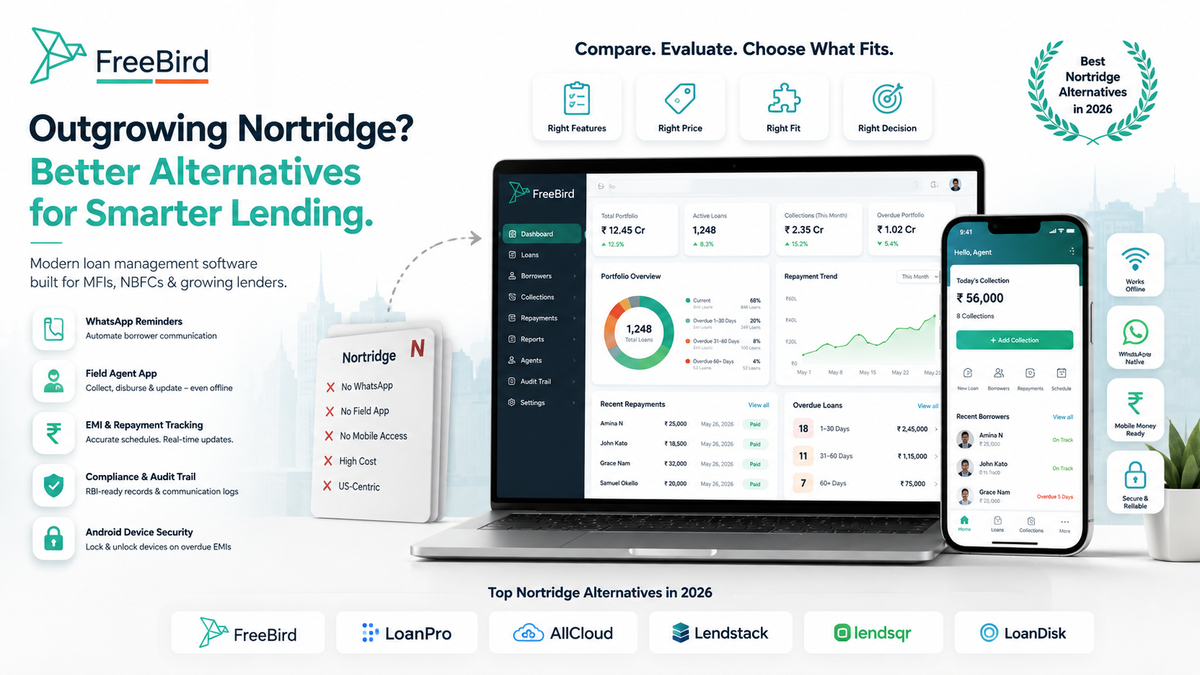
Nortridge Loan System is enterprise software built for large US consumer finance companies and credit unions. If you're running a microfinance institution, an NBFC, or a small lending operation outside the United States, it was never designed for you.
That's not a criticism. It's just worth being honest about.
If you're here, you're probably managing somewhere between 50 and 2,000 active borrowers, spending too many hours on manual payment follow-ups, and wondering whether there's software that actually fits your operation. This article walks through what to evaluate when looking for a Nortridge alternative in 2026, and which platforms are worth your time depending on where you operate and how you collect.
Why Lenders Look for Nortridge Alternatives
Nortridge does what it's built to do. But it carries enterprise pricing, a US-centric feature set, and an implementation model that assumes you have an IT team and a compliance department on staff.
For most MFIs and small NBFCs, that's three problems at once.
The gaps that push lenders to look elsewhere tend to follow a pattern:
- No WhatsApp-native reminders or borrower communication automation
- No Android field agent app for on-ground collections and disbursements
- No mobile-first borrower experience showing EMIs and payment history
- Pricing and contract structures built for institutions managing tens of thousands of loans, not hundreds
- No relevance to India, East Africa, or Southeast Asia lending workflows
If any of those describe your situation, the right question isn't "which platform is most like Nortridge?" It's "which platform is built for how I actually lend?"
What to Evaluate Before You Switch
Before you start comparing platforms, get clear on four things.
1. How Many Active Loans Are You Managing?
This shapes everything. A platform priced for 10,000 loans will either blow your budget or give you far more than you need if you're managing 200. Look for tiered pricing that matches your current portfolio with room to grow.
2. How Do You Collect?
If your field agents visit borrowers in person, you need a field agent app that works offline. If most of your borrower communication happens on WhatsApp, you need automated reminders going out before due dates, not after. If you're running EMI-based consumer lending on Android devices, device-level controls may be worth evaluating. Know your collection model before you start comparing features.
3. What Does Compliance Require?
If you're regulated by the RBI in India or a central bank in East Africa, you need audit-trail-enabled communication logs and borrower records that can be exported and presented during inspections. Not every platform builds this in. Some require a separate compliance tool layered on top.
4. What's Your Budget?
Enterprise loan platforms like Nortridge or LoanPro are priced for institutions with dedicated IT budgets. If your monthly software spend sits between USD 50 and 300, you need a platform built for that range, not one that treats it as a rounding error.
Nortridge Alternatives Worth Evaluating in 2026
Freebird
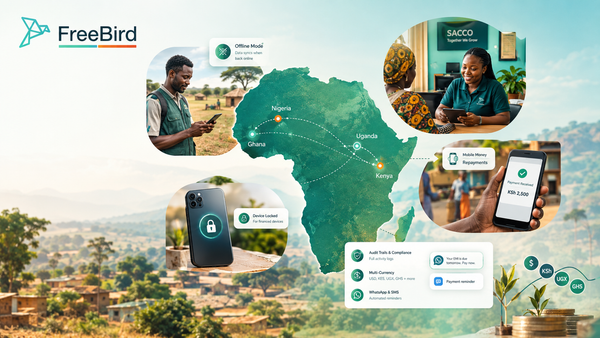
Freebird is loan management software built specifically for MFIs, village finance companies, and small NBFCs managing anywhere from 10 to 1,000 or more active borrowers. It's the most direct alternative for lenders who need operational depth at a price point Nortridge can't touch.
Here's what matters most if you're coming from Nortridge or a spreadsheet:
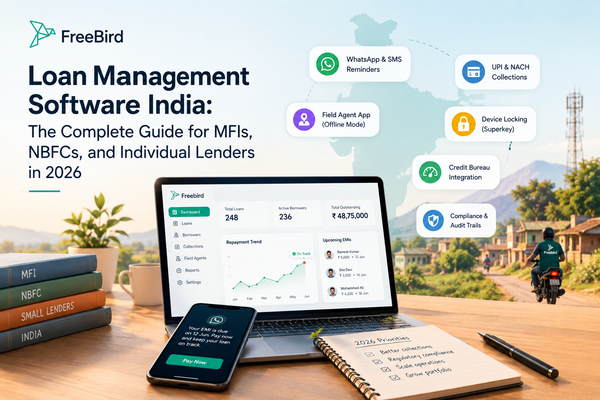
WhatsApp and SMS automation. Freebird sends automated payment reminders before due dates via WhatsApp and SMS, without you writing a single message manually. If you're currently spending three to five hours a week on follow-up messages, that time comes back to you.
Field agent app with offline capability. Field agents can record collections and disbursements on the ground even without a data connection. Records sync automatically when connectivity returns.
Borrower-facing mobile app. Borrowers can see their upcoming EMIs and payment history on their own device, which cuts down on the "when is my next payment?" calls to your team.
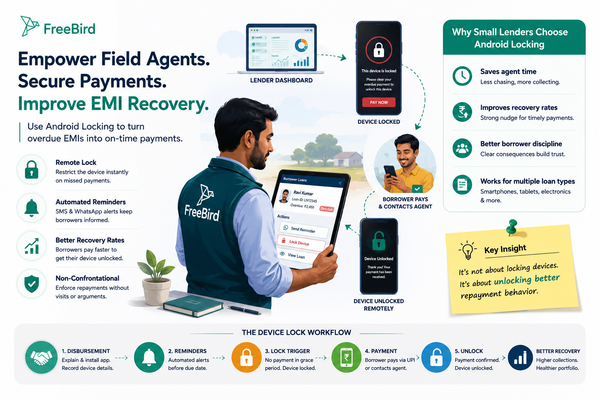
Android device locking for EMI-based consumer lending. For lenders running EMI-based consumer loans on Android devices, Freebird's optional Superkey feature remotely restricts a borrower's device until an overdue payment is cleared. Nothing else at this price point does this. It's specific to Android devices and EMI-based consumer lending, not applicable to every loan type.
Audit-trail-enabled compliance logs. Every borrower communication and transaction is logged and exportable, built to satisfy RBI and central bank reporting requirements without a separate compliance tool.
Cash flow forecasting dashboards. You see what's coming in before the end of the month, not after it's already passed.
Freebird is available on web, Android, and iOS. Pricing runs across three tiers: Lite (up to 50 active loans), Professional (up to 500 active loans), and Team (unlimited active loans). Billing is month-to-month with no long-term contracts, and a 7-day free trial is available with no credit card required.
If you're in East Africa, WhatsApp automation is the feature to focus on. If you're in India, both WhatsApp automation and device locking are directly relevant to how you collect.
LoanPro
LoanPro is an API-first enterprise platform built for large US-based lenders. It's powerful, but priced accordingly, with annual costs typically starting somewhere between USD 20,000 and 50,000. If you're managing 50 to 500 loans, that structure makes LoanPro impractical before you even look at features. There's no WhatsApp integration, no field agent app, and no mobile-first borrower experience designed for markets outside North America.
Worth knowing about. Not a realistic option for most MFIs or small NBFCs.
AllCloud
AllCloud targets mid-market NBFCs and banks in India with a full origination-to-collections SaaS suite, covering more of the loan lifecycle than most small-lender platforms. Pricing is demo-gated and likely structured on annual contracts.
The gaps: no clear evidence of WhatsApp-native reminders, no Android device locking, and no mobile-first field agent features. If your collection model depends on field agents or WhatsApp, AllCloud may not serve that need well.
Lendstack
Lendstack targets the small-lender segment in India with UPI payment collection and WhatsApp reminders. If your primary need is payment collection and borrower messaging, it's a reasonable starting point.
The gaps become significant as your portfolio grows: no field agent management, no compliance reporting, no cash flow dashboard, and no device-locking capability. If you need audit-trail-enabled records or a field operations layer, Lendstack will run short.
Lendsqr
Lendsqr has a strong reputation in West Africa, particularly Nigeria, covering origination, disbursement, and collections with a clean interface. For lenders in West Africa, it's worth evaluating alongside Freebird.
For lenders in India or East Africa, the regional focus and feature set may not align as well. Freebird positions itself as comparable in quality to Lendsqr but more cost-effective for MFIs managing 50 to 500 borrowers.
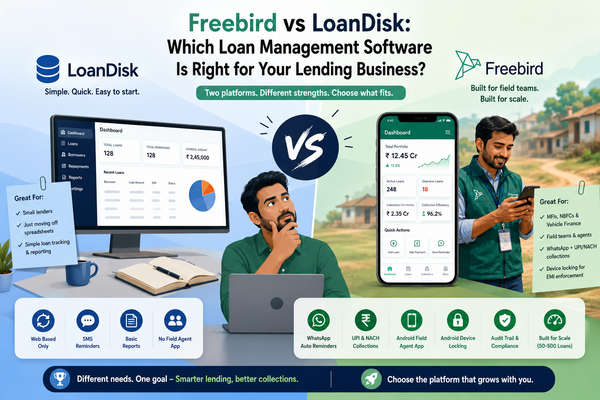
LoanDisk
LoanDisk is a web-based platform used by small MFIs and individual lenders for basic loan tracking, repayment schedules, and borrower records. It's accessible and relatively straightforward to set up.
The limitations are real: no WhatsApp automation, no field agent app, no device locking, and limited compliance reporting. For lenders who've just outgrown a spreadsheet, it works as a starting point. For lenders who need collections automation and field operations, it's a stepping stone rather than a destination.
How to Compare These Platforms Fairly
Use this checklist when evaluating any Nortridge alternative:
| Evaluation Criteria | Why It Matters |
|---|---|
| Active loan tier pricing | Avoid paying for capacity you don't use |
| WhatsApp automation | Cuts manual follow-up time significantly |
| Field agent app (offline-capable) | Essential for on-ground collections |
| Borrower mobile app | Reduces inbound queries from borrowers |
| Audit-trail-enabled logs | Required for RBI and central bank compliance |
| Cash flow dashboard | Shows collections in real time, not end-of-month |
| Device locking (EMI consumer lending) | Reduces defaults on Android-based EMI loans |
| Month-to-month billing | Avoids long-term contract lock-in |
| Free trial available | Lets you test before committing |
No platform will score perfectly on every row for every lender. The goal is to find the one that covers your highest-priority gaps without pushing you into enterprise pricing or a feature set built for a different market entirely.
The Honest Summary
Nortridge is enterprise US software. If you're managing loans in India, East Africa, or Southeast Asia with a portfolio between 50 and 2,000 borrowers, you were never the target customer.
The right alternative depends on your collection model, your compliance requirements, and your budget. For most MFIs and small NBFCs that need WhatsApp automation, field agent tools, and audit-trail-enabled records at a price that fits within USD 50 to 300 per month, Freebird is the most complete option available in 2026.
Whether you're at 10 borrowers or 1,000, Freebird is built to grow with your portfolio.
Request a live demo or start a 7-day free trial with no credit card at usefreebird.com.
Frequently Asked Questions
Is Nortridge suitable for lenders outside the United States?
Nortridge is designed for the US consumer finance market. It lacks WhatsApp integration, field agent apps, and features relevant to India or East Africa lending workflows. Most MFIs and small NBFCs operating outside the US will find it both over-engineered and under-equipped for their actual needs.
What's the most important feature to look for in a Nortridge alternative?
It depends on your collection model. If you rely on field agents, prioritise an offline-capable field agent app. If most of your borrower communication happens on WhatsApp, automated reminders are the first thing to evaluate. If you're regulated, audit-trail-enabled communication logs are non-negotiable.
Can small MFIs afford enterprise loan management software?
Most enterprise platforms, including Nortridge and LoanPro, are priced for institutions with dedicated IT budgets and large loan volumes. Platforms like Freebird are built specifically for MFIs and small NBFCs with budgets between USD 50 and 300 per month, with tiered pricing that starts at 50 active loans.
What is the Android device-locking feature and which lenders should consider it?
Called Superkey on Freebird, this feature remotely restricts a borrower's Android device until an overdue EMI payment is cleared. It's optional and specific to EMI-based consumer lending on Android devices. It's most relevant for lenders in India and Africa running consumer loan products where device financing is part of the picture.
Does Freebird require a long-term contract?
No. Freebird uses month-to-month billing with no long-term contracts. A 7-day free trial is available for all plans with no credit card required.
How does Freebird compare to LoanDisk or Lendsqr as a Nortridge alternative?
LoanDisk covers basic loan tracking but lacks WhatsApp automation, field agent tools, and compliance reporting. Lendsqr is strong in West Africa but less aligned with India and East Africa workflows. Freebird combines WhatsApp-native automation, an Android field agent app, device locking, and audit-trail-enabled compliance logs at a price point that's comparable to or lower than both platforms for lenders managing 50 to 500 borrowers.
What should I do if I'm currently on spreadsheets and considering a switch?
Start with a 7-day free trial on a platform that matches your portfolio size. Focus on the two or three features that would save you the most time, typically payment reminders, repayment tracking, and borrower records. Avoid paying for origination workflows or enterprise integrations you won't realistically use in the first six months.