Loan Management Software India: The Complete Guide for MFIs, NBFCs, and Individual Lenders in 2026
- Why Indian Lenders Face a Different Set of Challenges
- What RBI's 2026 Regulatory Changes Mean for Your Lending Business
- Features That Actually Matter for India in 2026
- WhatsApp and SMS Automated Reminders
- UPI and NACH Auto-Debit Collection
- Android Field Agent App with Offline Mode
- Android Device Locking (Superkey)
- Credit Bureau Integration
- Compliance-Friendly Audit Trails
- How to Evaluate Loan Management Software for Your Portfolio Size
- Where Freebird Fits in the Indian Market
- Frequently Asked Questions
- The Bottom Line
If you're running a lending operation in India, loan management software has moved well past the "nice-to-have" category. Whether you're managing 80 microfinance borrowers in a rural district or 3,000 NBFC accounts across multiple branches, the operational weight of manual tracking, missed EMIs, and compliance paperwork compounds fast. This guide covers what loan management software means for the Indian market specifically, which features actually matter here, how to evaluate your options, and why the regulatory environment in 2026 makes getting this right more urgent than ever.
Why Indian Lenders Face a Different Set of Challenges
Lending in India is operationally dense. You're dealing with borrowers who may not have reliable internet access, field agents collecting repayments on motorcycles, EMI schedules tied to agricultural cycles, and a regulatory framework that has grown significantly more demanding since the Reserve Bank of India introduced its Scale Based Regulation framework.
The problems that bring most Indian lenders to loan management software tend to look like this:
- Spreadsheet chaos. Loan officers maintain separate Excel files per borrower. When someone leaves, institutional knowledge walks out with them.
- Manual EMI follow-ups. Someone is calling borrowers one by one, every month, to remind them about dues. That doesn't scale past 100 loans.
- Cash collection gaps. Field agents collect repayments in cash, record them on paper, and reconcile at end of day. Errors and leakage are common.
- Defaults that arrive late. By the time a borrower shows up as delinquent in a manual system, they may already be 60 days overdue.
- Compliance pressure. RBI's regulatory changes require documentation that a spreadsheet simply cannot provide.
These aren't generic software problems. They're specific to how lending actually works in India — especially for MFIs, vehicle finance companies, and small NBFCs operating below the threshold where large enterprise platforms bother to compete.
What RBI's 2026 Regulatory Changes Mean for Your Lending Business
RBI's Scale Based Regulation framework, with Amendment Directions effective April 1, 2026, has tightened governance requirements for NBFCs across all layers. The direction is clear: better documentation, stronger audit trails, more rigorous internal controls.
For small and mid-sized NBFCs, this creates a practical problem. You may not have a compliance team. You may not have a system that automatically logs every disbursement, repayment, modification, or borrower communication. And if an RBI inspection asks for records, a folder of spreadsheets is not a satisfying answer.
Audit-trail-enabled loan management software addresses this directly. Every action in the system — from loan creation to final closure — is timestamped and attributed to a specific user. That kind of record-keeping is hard to fake and impossible to replicate manually at any meaningful scale.
Features That Actually Matter for India in 2026
Not all loan management software is built for the Indian market. Here's what separates useful tools from generic ones.
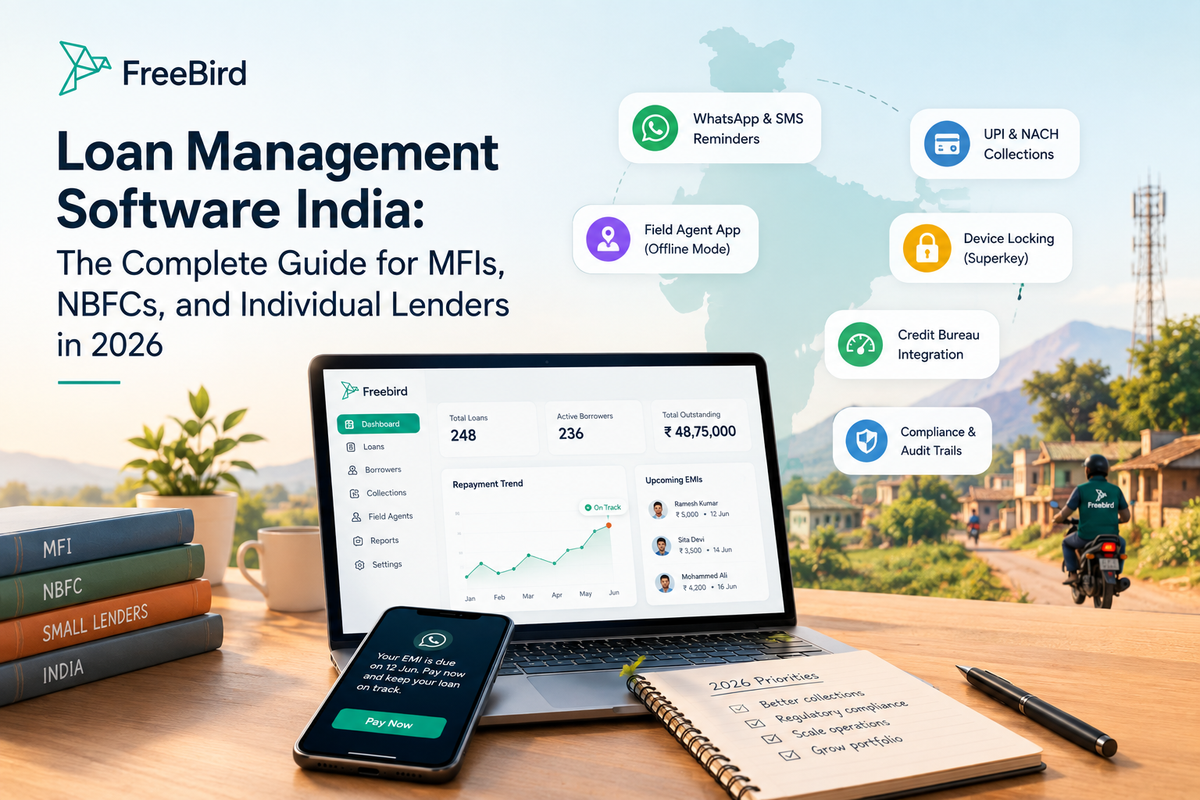
WhatsApp and SMS Automated Reminders
India has over 500 million WhatsApp users, and your borrowers are already on it. A platform with WhatsApp-native automation can send EMI reminders, overdue notices, and payment confirmations without any manual intervention. Lenders who've made the switch consistently report fewer late payments as a result.
SMS remains important for borrowers in low-connectivity areas where smartphones aren't universal.
UPI and NACH Auto-Debit Collection
Manual cash collection is the single biggest operational bottleneck for Indian lenders. UPI and NACH auto-mandate integrations let you pull repayments directly from borrowers' bank accounts on the due date. Failed mandates get flagged automatically, so your team knows exactly who to follow up with instead of chasing everyone.
This is India-specific infrastructure. Any loan management platform targeting Indian lenders should have it built in — not bolted on as an afterthought.
Android Field Agent App with Offline Mode
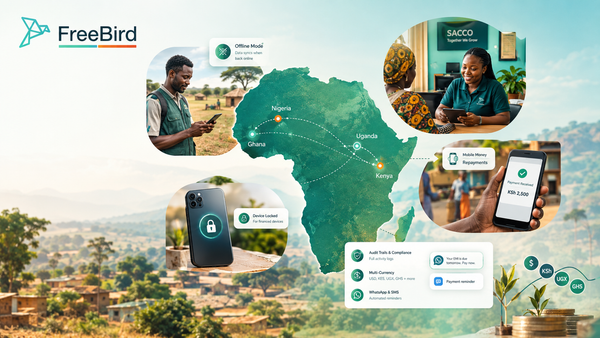
Many MFI and VFC field agents work in areas with poor or no connectivity. A mobile app that functions offline, syncs when a connection becomes available, and lets agents record collections, photograph documents, and update loan status on the ground isn't optional for these lenders. It's the difference between a system that works in the field and one that only works in the office.
Android Device Locking (Superkey)
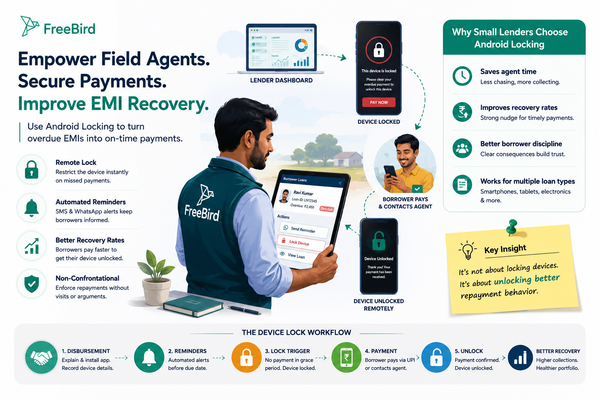
Only a small number of platforms globally offer this. For lenders who finance Android smartphones, tablets, or other devices, device locking allows the lender to remotely restrict a borrower's device if they miss a repayment. The device becomes unusable for standard functions until the EMI is paid. It's a powerful collections enforcement tool used across India and parts of Africa, and it dramatically reduces default rates on device-backed loans.
Credit Bureau Integration
For NBFCs and MFIs operating under RBI oversight, pulling credit bureau data before disbursement is both a risk management step and a compliance signal. Software with built-in bureau integration makes this part of the standard workflow rather than a separate manual process.
Compliance-Friendly Audit Trails
Every loan event should be logged automatically — disbursements, repayments, waivers, restructurings, agent actions, borrower communications. This is what regulators want to see, and it's what protects you if a borrower disputes a transaction.
How to Evaluate Loan Management Software for Your Portfolio Size
The Indian market has options across a wide range of price points and complexity levels.
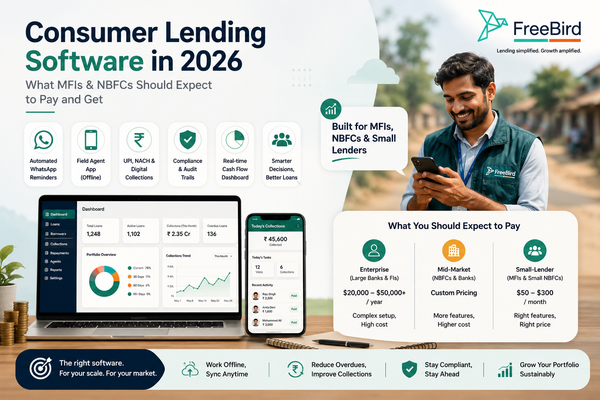
50 to 500 borrowers: This is the segment most underserved by enterprise platforms. You need something that works out of the box, doesn't require a six-month implementation, and costs well under $300 per month. Self-serve tools in this range can handle most MFI and small NBFC workflows without IT support.
500 to 5,000 borrowers: At this scale, you need more configurability, stronger reporting, and multi-user access controls. You're likely running multiple loan products, managing field teams, and facing more formal audit requirements. Mid-tier platforms can handle this without the $20,000 to $50,000 per year price tags that enterprise systems carry.
5,000+ borrowers: Enterprise platforms with dedicated implementation support, custom integrations, and SLA-backed uptime become relevant here — typically for large NBFCs and established MFI networks.
When evaluating any platform, these are the questions worth asking:
- Does it support UPI and NACH mandates natively?
- Does it have a field agent app that works offline?
- Is WhatsApp automation built in, or does it require a third-party integration?
- Does it maintain an audit trail that satisfies RBI documentation requirements?
- What does onboarding actually look like, and how long does it take?
- Is pricing transparent, or do you need a sales call just to get a number?
Where Freebird Fits in the Indian Market
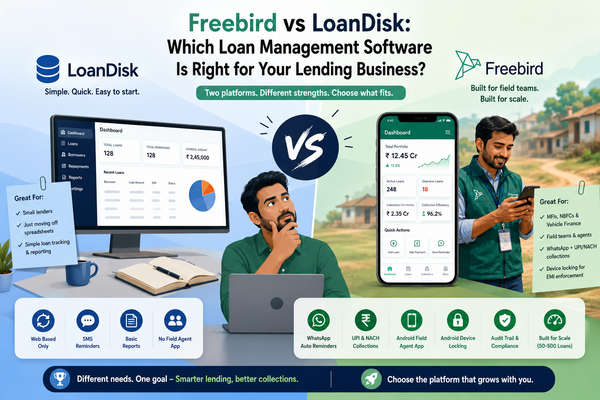
Freebird is built specifically for lenders in this segment. It brings together WhatsApp-native automation, UPI and NACH auto-debit, an Android field agent app with offline capability, Superkey device locking, and credit bureau integration into a single platform — designed for MFIs, VFCs, and small NBFCs managing anywhere from 50 to several thousand borrowers.
The platform is positioned as a cost-effective alternative to enterprise-grade systems that price out smaller lenders before they even reach a demo. For Indian lenders who need the full feature stack without the enterprise price tag, it's worth a conversation. You can explore it at usefreebird.com.
Frequently Asked Questions
What is loan management software and why do Indian lenders need it?
Loan management software automates the full loan lifecycle — from disbursement through repayment and closure. Indian lenders need it to replace manual tracking, reduce defaults through automated reminders, collect via UPI and NACH, and maintain the audit trails required under RBI's regulatory framework.
Does loan management software in India support UPI and NACH?
The better platforms do. UPI and NACH auto-mandate integration is a core requirement for any Indian lending operation that wants to move away from manual cash collection. Confirm it's built in natively before committing to any platform.
What is Superkey or Android device locking, and who uses it?
Device locking allows lenders to remotely restrict an Android device if a borrower misses a repayment. It's used primarily by lenders who finance smartphones and tablets, in India and Africa, and is one of the most effective collections enforcement tools available for device-backed lending.
How does RBI's Scale Based Regulation affect small NBFCs?
The SBR framework, with Amendment Directions effective April 1, 2026, requires stronger governance, documentation, and internal controls across all NBFC layers. In practice, this means small NBFCs need systems that produce reliable audit trails and structured records — not just spreadsheets.
What should a small MFI with 100 to 300 borrowers look for in software?
Ease of onboarding, WhatsApp reminders, UPI or NACH collection, a field agent mobile app, and pricing that fits a sub-$300/month budget. You don't need enterprise complexity at this scale, but you do need the India-specific feature stack.
How is loan management software different from a loan origination system?
Origination software handles the application, underwriting, and approval process. Loan management software takes over after disbursement and manages the ongoing relationship — repayments, collections, and closure. Some platforms combine both; others specialize in one.
Is Freebird suitable for vehicle finance companies in India?
Yes. VFCs have specific needs around field collections, device locking for financed devices, and EMI tracking across large borrower bases. Freebird's Android field agent app and Superkey integration are directly relevant to this use case.
The Bottom Line
India's lending market is large, diverse, and increasingly regulated. The tools that worked when your portfolio was 30 borrowers on a spreadsheet stop working somewhere around 80 — and by the time you reach 300, they're actively creating risk. Loan management software built for the Indian market, with WhatsApp automation, UPI and NACH collection, field agent apps, and compliance-ready audit trails, is what closes that gap.
If you're evaluating options for your MFI, NBFC, or vehicle finance operation, start at usefreebird.com to see how Freebird handles the full workflow.