NBFC Loan Management Software: Essential Features and Compliance Guide 2026
Everything NBFCs need in loan management software — RBI compliance, audit trails, automation, and portfolio tracking. Choose the right system for your operations in 2026.
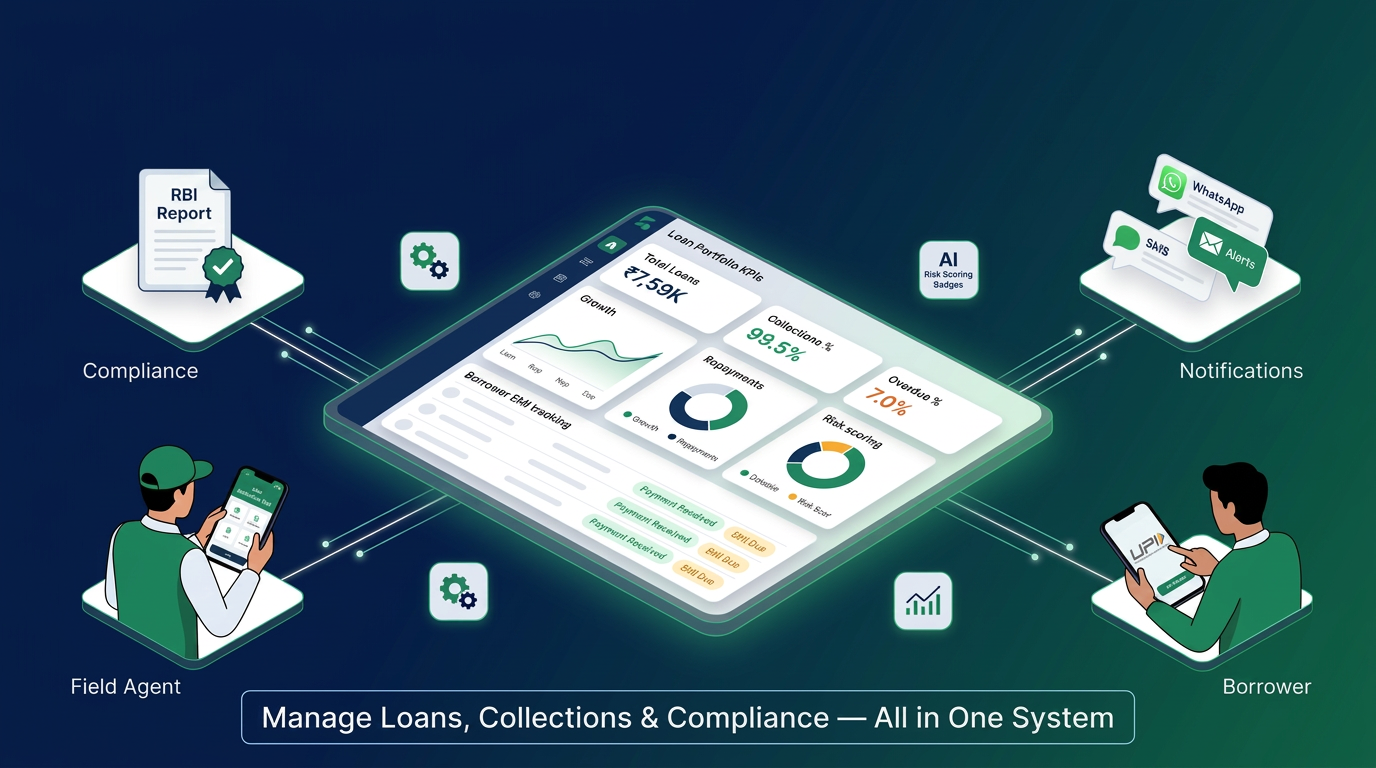
Running an NBFC in 2026 without proper loan management software is like trying to navigate without a GPS. You might reach your destination, but the journey will be longer, costlier, and full of wrong turns.
NBFCs face unique challenges that generic financial software can't address. From RBI compliance requirements to field agent coordination, your loan management system needs to handle complex workflows while keeping operations simple enough for daily use.
This guide covers everything you need to know about selecting and implementing NBFC loan management software that actually works for your business.
Understanding NBFC Loan Management Software
NBFC loan management software serves as the operational backbone for non-banking financial companies. Unlike traditional banking systems, NBFCs operate with different regulatory frameworks, customer segments, and business models that require specialized software solutions.
The software manages your entire loan lifecycle from application processing to final repayment. It tracks borrower information, automates payment reminders, generates compliance reports, and provides real-time visibility into your portfolio health.
For small to mid-sized NBFCs managing 10 to 1,000+ borrowers, the right software eliminates manual processes that consume hours of staff time weekly. Instead of chasing payments through phone calls and maintaining borrower records in spreadsheets, automated systems handle routine tasks while you focus on growing your business.
Modern NBFC software also addresses field operations. Your agents can access borrower information, process disbursements, and record collections directly from mobile apps, ensuring data accuracy and real-time updates.
Core Features Every NBFC Needs
Borrower Management System
Your software should maintain comprehensive borrower profiles including personal information, loan history, payment patterns, and communication logs. This creates a complete view of each customer relationship.
Look for systems that track multiple loans per borrower and maintain family or group lending relationships common in microfinance operations. The ability to link guarantors and co-applicants ensures you have complete visibility into your risk exposure.
Loan Origination and Processing
Efficient loan origination features streamline application processing from initial inquiry to disbursement. The system should support different loan products, interest calculation methods, and approval workflows.
Document management capabilities ensure all required paperwork is collected and stored digitally. This eliminates lost documents and speeds up the approval process while maintaining audit trails for compliance purposes.
EMI and Payment Tracking
Accurate EMI calculations and payment tracking form the foundation of loan management. Your software should handle various interest calculation methods, grace periods, and penalty structures automatically.
Real-time payment tracking shows exactly who has paid, who is overdue, and by how much. This visibility enables proactive collections before small delays become major defaults.
Field Agent Mobile App
Since many NBFC operations involve field agents, mobile app functionality is essential. Agents need to access borrower information, record payments, and process new applications while on the ground.
The mobile app should work offline and sync data when connectivity returns. This ensures operations continue smoothly even in areas with poor network coverage.
Regulatory Compliance Requirements
RBI Compliance Framework
NBFCs must comply with Reserve Bank of India regulations covering capital adequacy, asset classification, provisioning norms, and reporting requirements. Your loan management software should generate all required regulatory reports automatically.
The system must maintain proper asset classification based on days past due and automatically calculate provisioning requirements. This ensures your books remain compliant without manual intervention.
Audit Trail Requirements
Every transaction, modification, and system access must be logged with timestamps and user identification. This creates an unbreakable audit trail that satisfies regulatory scrutiny.
Look for software that tracks who accessed what information when, what changes were made to borrower records, and maintains communication logs for all customer interactions.
Data Privacy and Security
NBFC software must comply with data protection regulations while maintaining robust security measures. This includes encrypted data storage, secure user authentication, and controlled access to sensitive information.
The system should allow role-based access control so different staff members see only the information relevant to their responsibilities. This reduces data exposure while maintaining operational efficiency.
Reporting and Documentation
Automated generation of regulatory reports saves significant time while ensuring accuracy. Your software should produce returns required by RBI, including asset quality reports, prudential returns, and other compliance documents.
Documentation features should maintain proper loan agreements, repayment schedules, and borrower communications in formats that satisfy regulatory requirements.
Automation Features That Save Time
Automated Payment Reminders
Manual follow-up calls consume hours of staff time weekly. Automated WhatsApp and SMS reminders sent before EMI due dates significantly reduce the need for manual outreach.
The system should send personalized reminders with payment amounts, due dates, and payment methods. Borrowers receive timely notifications while your staff focuses on higher-value activities.
Auto-debit and Digital Payments
Integration with auto-debit systems and digital payment platforms reduces collection effort. Borrowers can set up automatic payments while you receive funds directly into your accounts.
Support for UPI, NEFT, RTGS, and other digital payment methods makes it convenient for borrowers to pay while ensuring faster fund realization for your NBFC.
Workflow Automation
Automated workflows handle routine processes like loan approvals, disbursement authorization, and overdue account classification. This reduces manual errors while ensuring consistent process execution.
The system should automatically escalate overdue accounts through different collection stages and generate appropriate notices and reports at each stage.
Communication Automation
Beyond payment reminders, automated communication includes welcome messages for new borrowers, payment confirmations, and account statements. This maintains regular customer engagement without manual effort.
Automated communication logs satisfy compliance requirements while keeping borrowers informed about their account status.
Portfolio Management and Risk Assessment
Real-time Portfolio Analytics
Dashboard views provide instant visibility into portfolio health, including total outstanding amounts, collection efficiency, and overdue percentages. This enables quick decision-making based on current data.
Portfolio segmentation by loan products, agent territories, or borrower categories helps identify trends and performance patterns across different business segments.
Risk Scoring and Assessment
Built-in risk assessment tools analyze borrower payment patterns, demographic factors, and historical performance to generate risk scores. This helps in pricing decisions and collection prioritization.
The system should flag high-risk accounts early and suggest appropriate intervention strategies based on historical data and borrower behavior patterns.
Cash Flow Forecasting
Accurate cash flow projections based on scheduled EMIs and historical collection patterns help in liquidity planning. You can anticipate funding needs and optimize resource allocation.
The system should account for seasonal variations, borrower behavior patterns, and economic factors that affect collection rates in your operating regions.
Performance Monitoring
Track key performance indicators including portfolio at risk, collection efficiency, and agent productivity. Regular monitoring helps identify issues before they impact business performance.
Comparative analysis across time periods, loan products, and agent territories provides insights for operational improvements and strategic planning.
Collections and Recovery Tools
Multi-channel Communication
Effective collections require multiple communication channels. Your software should support SMS, WhatsApp, email, and voice calls for reaching borrowers through their preferred methods.
Communication scheduling ensures messages reach borrowers at appropriate times while maintaining professional tone and compliance with communication guidelines.
Field Collections Management
Field agent tools enable on-ground collections with mobile receipt generation, GPS tracking, and real-time data updates. This ensures accurate recording of field collections and agent accountability.
Route optimization helps agents plan efficient collection visits while tracking actual vs. planned activities provides insights into field operation effectiveness.
Legal and Recovery Processes
For accounts requiring legal action, the system should maintain complete documentation, track legal proceedings, and generate required notices and reports.
Recovery workflow management ensures appropriate escalation procedures are followed while maintaining detailed records of all recovery actions taken.
Settlement and Write-off Management
When accounts require settlement negotiations or write-offs, proper documentation and approval workflows ensure these decisions are recorded appropriately for regulatory and accounting purposes.
The system should maintain complete audit trails for all settlement decisions and write-off actions to satisfy regulatory scrutiny.
Reporting and Analytics Capabilities
Regulatory Reporting
Automated generation of RBI returns, asset quality reports, and other regulatory documents saves significant time while ensuring accuracy and compliance.
The system should handle complex calculations required for regulatory reports and maintain historical data for trend analysis and comparative reporting.
Management Information System (MIS)
Comprehensive MIS reports provide insights into business performance, agent productivity, and portfolio quality. These reports support strategic decision-making and operational improvements.
Customizable report formats allow you to focus on metrics most relevant to your business model and operational requirements.
Business Intelligence and Analytics
Advanced analytics capabilities identify trends, predict borrower behavior, and optimize business processes. This includes cohort analysis, vintage analysis, and predictive modeling.
Visual dashboards present complex data in easily understandable formats, enabling quick identification of opportunities and risks.
Agent Performance Tracking
Detailed agent performance reports track disbursements, collections, and portfolio quality by individual agents. This enables performance-based incentives and targeted training programs.
Comparative analysis helps identify best practices from high-performing agents that can be replicated across your organization.
Choosing the Right Software for Your NBFC
Scalability Considerations
Your software should grow with your business from 10 borrowers to 1,000+ without requiring complete system changes. Look for solutions with usage-based pricing that scales with your portfolio size.
The system architecture should handle increasing transaction volumes and user counts without performance degradation.
Integration Capabilities
Modern NBFCs use multiple systems for accounting, core banking, and regulatory reporting. Your loan management software should integrate seamlessly with existing systems to avoid data silos.
API capabilities enable integration with payment gateways, SMS providers, and other third-party services essential for NBFC operations.
User Experience and Training
Software adoption depends on user-friendly interfaces that require minimal training. Look for solutions designed for real-world lending operations rather than complex enterprise systems.
Mobile-first design ensures field agents and borrowers can use the system effectively regardless of their technical expertise.
Vendor Support and Reliability
Choose vendors with proven track records in NBFC software and strong support capabilities. Regular updates, bug fixes, and feature enhancements ensure your system remains current and reliable.
Local support presence helps resolve issues quickly and provides training and customization services when needed.
Implementation and Setup Considerations
Data Migration Planning
Moving from spreadsheets or legacy systems requires careful data migration planning. Ensure your new software can import existing borrower data, loan details, and payment histories accurately.
Data validation processes should identify and correct inconsistencies before going live with the new system.
Staff Training and Change Management
Successful implementation requires comprehensive staff training and change management. Plan for training programs that cover both technical system usage and new operational processes.
Gradual rollout approaches allow staff to adapt to new systems while maintaining business continuity during the transition period.
System Configuration
Configure the system to match your specific loan products, interest calculation methods, and operational workflows. This customization ensures the software supports your business model effectively.
Test all configurations thoroughly before going live to identify and resolve any issues that could disrupt operations.
Go-live Support
Choose vendors who provide dedicated go-live support to address issues that arise during initial system usage. This support is critical for smooth transition and user confidence.
Have backup procedures ready in case system issues require temporary fallback to manual processes during the initial implementation period.
Cost Factors and ROI Analysis
Software Licensing Costs
NBFC loan management software typically uses usage-based pricing scaled by number of active borrowers. This aligns costs with business growth while keeping initial investments manageable.
Compare total cost of ownership including licensing, implementation, training, and ongoing support costs when evaluating different solutions.
Operational Cost Savings
Automation reduces staff time spent on manual processes like payment follow-ups, report generation, and borrower communication. Calculate these time savings to determine software ROI.
Improved collection efficiency and reduced defaults provide additional financial benefits that often exceed software costs within the first year of implementation.
Compliance Cost Reduction
Automated regulatory reporting and audit trail maintenance reduce compliance costs while minimizing regulatory risk. These benefits become more valuable as your NBFC grows and faces increased scrutiny.
Avoiding regulatory penalties and audit findings provides significant cost savings that justify software investments.
Productivity Improvements
Staff productivity improvements from automated workflows and better information access enable business growth without proportional staff increases.
Better decision-making from real-time data and analytics leads to improved portfolio performance and reduced operational risks.
Future-Proofing Your NBFC Operations
Technology Trends
Cloud-based systems, artificial intelligence, and mobile-first design represent the future of NBFC software. Choose solutions that incorporate these technologies to remain competitive.
API-first architectures enable integration with emerging fintech solutions and payment platforms that can enhance your service offerings.
Regulatory Evolution
RBI regulations continue evolving with new requirements for digital lending, data protection, and risk management. Your software should adapt to regulatory changes without major system overhauls.
Choose vendors who actively monitor regulatory developments and update their software accordingly.
Market Expansion
As your NBFC grows, you may expand into new geographic markets or loan products. Your software should support multi-location operations and diverse product offerings.
Scalable architecture ensures your system can handle business expansion without performance issues or major infrastructure changes.
Customer Expectations
Borrowers increasingly expect digital services including online applications, payment options, and account access. Your software should support these customer-facing capabilities.
Modern borrower portals and mobile apps enhance customer experience while reducing operational costs through self-service capabilities.
For NBFCs ready to modernize their operations with automated loan management and collections, platforms like Freebird provide comprehensive solutions designed specifically for lending businesses. From 10 borrowers to 1,000+, Freebird grows with your portfolio while maintaining compliance-ready audit trails and communication logs that satisfy NBFC regulatory requirements.
Learn more at usefreebird.com to see how automated WhatsApp reminders, real-time borrower tracking, and field agent mobile apps can transform your NBFC operations.
FAQs
What are the essential features every NBFC loan management software must have?
NBFC loan management software must include borrower management, EMI tracking, automated payment reminders, field agent mobile apps, regulatory reporting, and audit trail capabilities. The system should also support multiple loan products, interest calculation methods, and compliance requirements specific to NBFC operations.
How does NBFC software ensure regulatory compliance with RBI requirements?
NBFC software ensures compliance through automated regulatory report generation, proper asset classification based on days past due, audit trail maintenance, and data security measures. The system should automatically calculate provisioning requirements and generate all required RBI returns while maintaining complete documentation for regulatory scrutiny.
What is the typical cost structure for NBFC loan management software in 2026?
Most NBFC software uses usage-based pricing scaled by number of active borrowers, typically ranging from a few thousand to tens of thousands of rupees monthly depending on portfolio size and features enabled. This pricing model aligns costs with business growth while keeping initial investments manageable for smaller NBFCs.
How long does it typically take to implement NBFC loan management software?
Implementation timeframes vary from a few weeks for simple setups to several months for complex NBFCs with extensive customization needs. Factors affecting timeline include data migration complexity, staff training requirements, system configuration needs, and integration with existing systems.
Can NBFC software integrate with existing accounting and banking systems?
Modern NBFC software should offer API capabilities for integration with accounting systems, core banking platforms, payment gateways, and regulatory reporting systems. This integration eliminates data silos and ensures seamless information flow across all business systems.
What mobile capabilities should NBFC software provide for field agents?
Field agent mobile apps should provide offline capability, borrower information access, payment recording, disbursement processing, GPS tracking, and real-time data synchronization. The app should work reliably in areas with poor network connectivity and sync data when connectivity returns.
How does automated collections software improve NBFC recovery rates?
Automated collections improve recovery through timely WhatsApp and SMS reminders, multi-channel communication, workflow automation, and early intervention capabilities. These features reduce manual follow-up time while maintaining consistent borrower engagement that prevents small delays from becoming major defaults.
Conclusion
Selecting the right NBFC loan management software is a strategic decision that impacts every aspect of your operations. The right system automates routine tasks, ensures regulatory compliance, and provides the visibility needed to grow your business confidently.
Focus on solutions designed specifically for NBFC operations rather than generic financial software. Look for scalable platforms that grow with your portfolio while maintaining the simplicity needed for daily operations.
Your borrowers get timely reminders and convenient payment options. You get real-time visibility into portfolio health and automated compliance reporting. The result is a more efficient operation that can scale from 10 borrowers to 1,000+ without losing control of your business.