Loan Origination System vs Loan Management System: A Plain-English Breakdown for MFIs
You've been searching for software to run your lending operation, and you keep running into two terms: loan origination system and loan management system. Some vendors use them interchangeably. Others treat them as completely separate products. And plenty of platforms claim to do both.
Here's a plain-English breakdown of what each one actually does, why the difference matters for MFIs and small NBFCs, and how to figure out what you actually need.
What a Loan Origination System Does
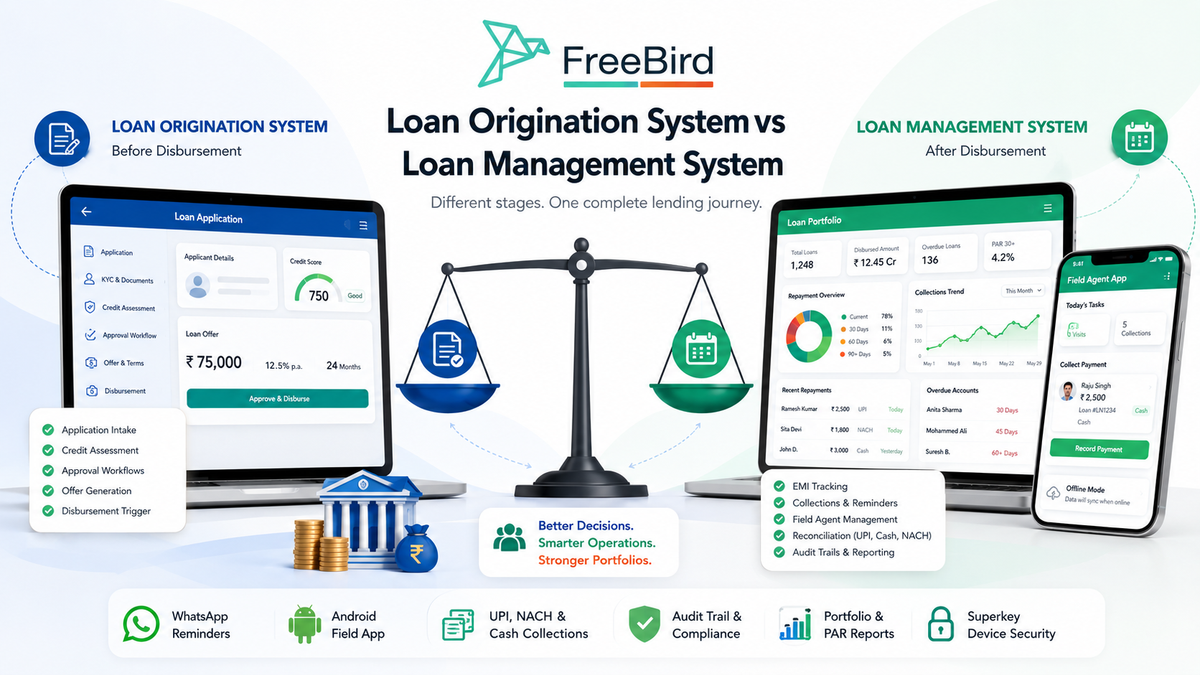
A loan origination system (LOS) handles everything that happens before a loan is disbursed. It's the front door of your lending process.
That includes:
- Application intake — collecting borrower details, documents, and consent
- Credit assessment — running bureau checks, scoring, and underwriting rules
- Approval workflows — routing applications through loan officers, branch managers, or credit committees
- Offer generation — calculating loan terms, interest rates, and repayment schedules
- Disbursement trigger — initiating the transfer once the loan is approved
Once the money leaves your account, the LOS's job is largely done.
For a large bank or fintech processing thousands of applications a day, a dedicated LOS makes sense. The volume justifies the complexity.
What a Loan Management System Does
A loan management system (LMS) takes over the moment a loan is disbursed. It manages everything that happens after.
That includes:
- EMI tracking — recording scheduled payments, due dates, and outstanding balances
- Collections management — flagging overdue accounts, triggering reminders, managing recovery workflows
- Field agent coordination — assigning visits, capturing payments in the field, syncing data back to the office
- Repayment reconciliation — matching incoming payments (UPI, cash, NACH) to the right borrower accounts
- Audit trails — maintaining compliance-friendly records of every transaction and action
- Reporting — portfolio health, PAR, overdue aging, disbursement summaries
The LMS is where you spend most of your operational time. It's the engine running your portfolio day to day.
Why MFIs Often Need One More Than the Other
Here's the honest reality for most MFIs, VFCs, and small NBFCs managing 50 to 5,000 borrowers: your origination process is relatively straightforward.
You know your borrowers. Many of them are repeat borrowers. Your loan products are simple — group loans, individual microloans, vehicle finance. You don't need a sophisticated underwriting engine with 40 decision variables.
What you need is a system that handles what happens after disbursement, reliably, every single day.
Late payments. Field collections. WhatsApp reminders. Reconciling cash collected by agents. Generating statements when borrowers ask for them. Staying audit-trail enabled for regulators.
That's 80% of your operational work. And that's exactly what an LMS is built for.
When You Actually Need a Loan Origination System
There are situations where a proper LOS becomes worth the investment:
- You're processing high application volumes — hundreds per week — and manual review is a bottleneck
- You need automated credit bureau pulls integrated directly into the approval workflow
- Your loan products have complex eligibility rules that vary by borrower segment
- Your regulatory environment requires documented, auditable underwriting decisions at the application stage
For most MFIs at the 50–500 borrower scale, none of these apply yet. You're approving loans through a loan officer who knows the borrower's history. The "origination system" is a form, a conversation, and a signature.
That doesn't mean origination doesn't matter. It means you don't need a separate, expensive system to manage it.
The Overlap: Platforms That Do Both
Many modern loan management platforms include basic origination features — borrower KYC capture, document attachment, loan application creation, approval before the loan moves into the active portfolio.
That's not a full LOS. But for most small lenders, it's enough.
What you're really evaluating is whether the platform handles post-disbursement work well: collections, reminders, field operations, reconciliation. That's where your team's time actually goes.
What to Look for in an LMS If You're an MFI
When you're managing 200 borrowers across a few branches, here's what actually matters:
- WhatsApp-native reminders — borrowers respond to WhatsApp, not email
- Offline-capable field agent app — your agents work in areas with poor connectivity; the app needs to function without it
- Cash and digital payment reconciliation — UPI, NACH, and cash all in one place
- Simple EMI scheduling — weekly, bi-weekly, monthly; group loans and individual loans
- Compliance-friendly audit trails — regulators and auditors will ask for records; you need them clean and accessible
- Affordable pricing — the software cost needs to match your portfolio size, not a bank's
These aren't nice-to-haves. They're table stakes for running a field-based lending operation.
Where Freebird Fits
usefreebird.com is a loan management system built for exactly this type of lender — MFIs, VFCs, and small NBFCs managing real borrowers in real communities.
It includes WhatsApp automation for payment reminders, an Android field agent app that works offline, UPI and NACH integration for India, and Superkey device locking for Android devices — relevant for operations in India and Africa. Every action is audit-trail enabled, which matters when regulators come asking.
It's not a full LOS with a 40-step underwriting engine, and it's not trying to be. It's built for the 80% of your work that happens after disbursement — and it does that well at a price point that makes sense for lenders at your scale.
If you've been looking at enterprise platforms and wondering why they feel overbuilt for your operation, this article on
usefreebird.com explains the mismatch clearly.
The Short Answer
Loan origination system = before disbursement. Application, approval, underwriting.
Loan management system = after disbursement. EMI tracking, collections, reconciliation, compliance.
Most MFIs and small NBFCs need a strong LMS. They need basic origination capability — not a dedicated LOS. If a vendor is pushing a complex origination platform at a lender approving 30 loans a week through a loan officer, that's the wrong fit.
Start with the system that manages your portfolio day to day. Get that right first.
FAQs
What is the difference between a loan origination system and a loan management system? A loan origination system handles the process of applying for, evaluating, and approving a loan before disbursement. A loan management system handles everything after — EMI tracking, collections, reconciliation, and reporting. They serve different stages of the loan lifecycle.
Do MFIs need a loan origination system? Most MFIs at the 50–500 borrower scale don't need a dedicated loan origination system. Their approval process runs through loan officers who know their borrowers personally. What they need is a reliable loan management system to handle collections, reminders, and portfolio tracking after disbursement.
Can one platform handle both loan origination and loan management? Yes. Many modern LMS platforms include basic origination features — borrower intake, document capture, loan approval workflows — before moving a loan into the active portfolio. For small lenders, this combined approach is usually sufficient.
What features should an MFI look for in a loan management system? Key features include WhatsApp-based payment reminders, an offline-capable field agent app, EMI scheduling for group and individual loans, UPI and NACH payment reconciliation, compliance-friendly audit trails, and pricing that fits a smaller portfolio.
When does it make sense to invest in a standalone loan origination system? A standalone LOS makes sense when you're processing high application volumes, need automated credit bureau integration in the approval workflow, or have complex underwriting rules that vary by borrower segment. For most small MFIs, basic origination features within an LMS are sufficient.
Is Freebird a loan origination system or a loan management system? Freebird is a loan management system. It handles the post-disbursement lifecycle — EMI tracking, WhatsApp reminders, field agent coordination, collections, and compliance-friendly audit trails. It includes basic loan creation and borrower onboarding, but it's not a dedicated underwriting or origination platform.
What is PAR in microfinance loan management? PAR stands for Portfolio at Risk. It measures the percentage of your loan portfolio where repayments are overdue beyond a set number of days — commonly 30 or 90. It's one of the most important health indicators for any MFI's portfolio and should be visible in whatever loan management system you use.