Consumer Lending Software in 2026: What MFIs and NBFCs Should Expect to Pay and Get
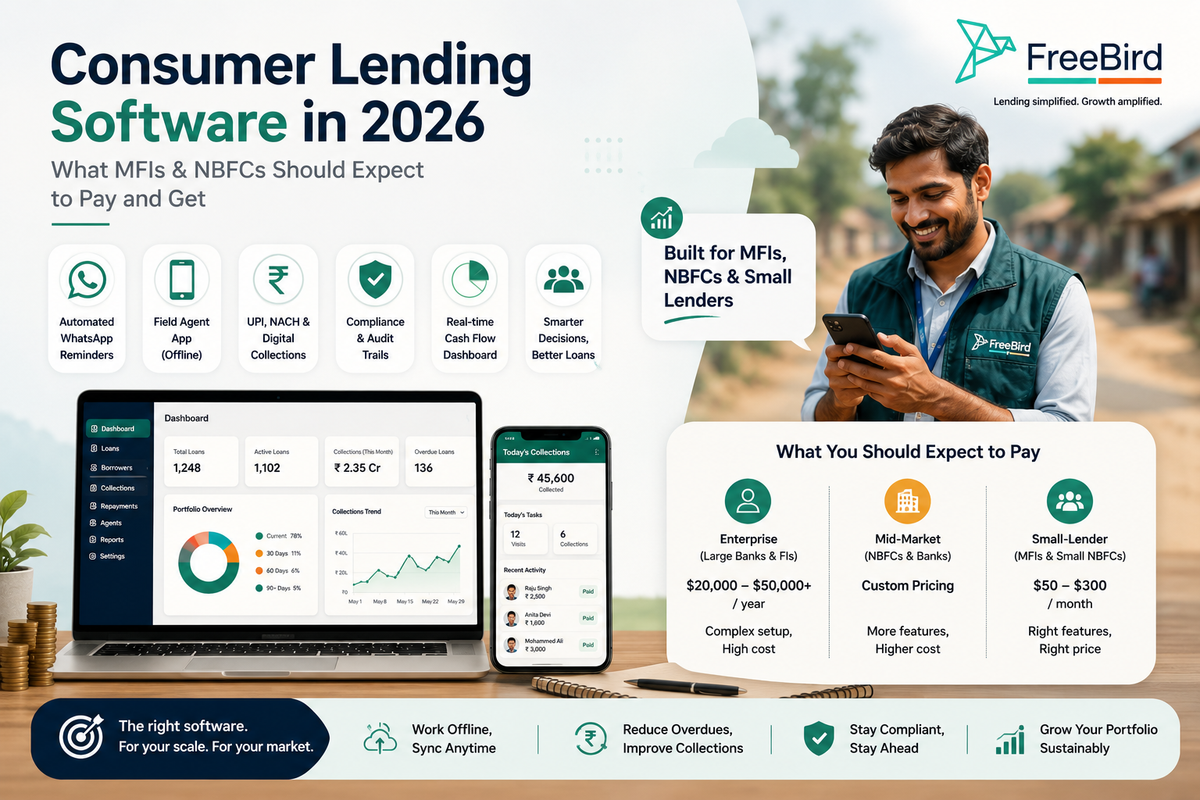
You've outgrown spreadsheets. Maybe you're managing 200 active loans, your field agents are spending half their day on WhatsApp chasing overdue EMIs, and repayments are slipping through the cracks simply because no one had time to follow up.
So you search for consumer lending software — and land on platforms built for US banks with six-figure implementation budgets. That's not your reality.
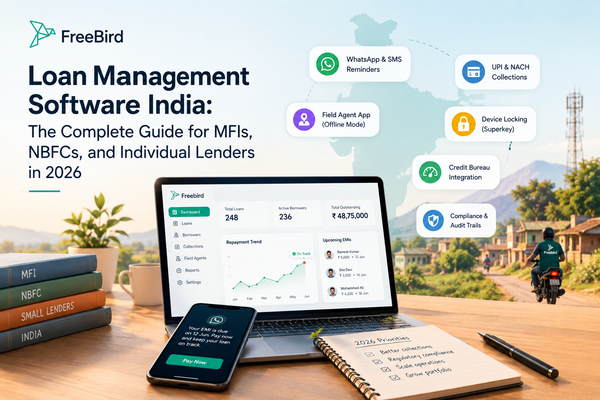
This article breaks down what MFIs, NBFCs, and small lenders should actually expect from lending software in 2026: which features matter, what you should reasonably pay, and where the real gaps in the market are.
The Consumer Lending Software Market Is Not Built for You (Yet)
Most consumer lending software was designed for large financial institutions. The vendors dominating search results are targeting banks, established fintechs, and mid-market lenders with dedicated IT teams and multi-year contracts.
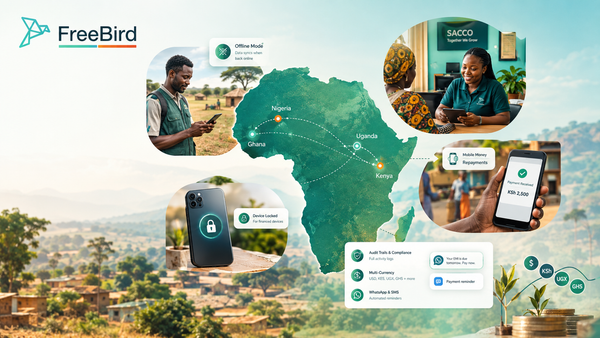
If you're managing 100 to 2,000 active loans in India, Uganda, Kenya, or a similar market, enterprise vendors have largely ignored your segment. That's both a problem and an opportunity.
The problem: you can't pick the top result and expect it to work for your operation. The opportunity: a small number of platforms have been built specifically for your scale, your workflows, and your market.
What You Should Actually Get From Lending Software in 2026
Before evaluating any platform, get clear on what your operation genuinely needs. Not every feature matters equally at every stage.
Core Loan Tracking
This is the baseline. Any platform worth considering should let you track active loans, borrower profiles, EMI schedules, outstanding balances, and repayment history — without manual data entry at every step.
If you're still updating a spreadsheet after every collection, you're not using software. You're using a digital notebook.
Automated Payment Reminders
Manual follow-up is the single biggest time drain for small lending operations. Your field agents should not be sending individual WhatsApp messages to 300 borrowers every week.
In 2026, automated SMS and WhatsApp reminders before due dates are table stakes. The better platforms send them on a schedule you configure, without your team touching anything.
Field Agent Management
If your collections happen in the field — and for most MFIs in India and East Africa, they do — you need a way to manage agents from a central system. That means assigning borrowers, tracking collections, and logging disbursements without waiting for agents to return to the office.
A dedicated mobile app for field agents, ideally with offline capability, is not a luxury. It's how you run a distributed lending operation without chaos.
Repayment Collection Integrations
UPI, auto-debit mandates, NACH — your borrowers pay through digital channels, and your software should support that natively. Chasing manual bank transfers for every EMI is a collections bottleneck you can eliminate.
Compliance-Friendly Audit Trails
Regulatory requirements for NBFCs and MFIs are not getting lighter. Your software should generate borrower communication logs and audit-trail-enabled records you can produce when your regulator asks.
If you're operating as a registered NBFC or MFI, this is not optional. It's a basic requirement — and not every platform takes it seriously.
Cash Flow Visibility
Knowing what's due this week versus next month is how you manage liquidity. A cash flow dashboard showing expected repayments against your disbursement commitments helps you make decisions before problems appear, not after.
What You Should Expect to Pay in 2026
This is where the market splits sharply.
Enterprise Pricing: Not for Your Scale
Platforms like LoanPro are priced at $20,000 to $50,000 or more annually. They require dedicated IT teams, multi-month implementations, and ongoing developer resources to configure and maintain.
If you're managing 500 loans on a SaaS budget of $50 to $300 per month, that pricing tier is simply out of reach. And even if you could afford it, you'd be paying for capabilities you don't need — API-first architecture built for large US-based financial institutions, not field-based collections in Kampala or Pune.
For a detailed breakdown of how enterprise platforms compare to small-lender options, the LoanPro alternatives guide for small lenders is worth reading.
Mid-Market Pricing: Closer, But Often Still Mismatched
Platforms like AllCloud serve mid-market NBFCs and banks in India. Pricing is demo-gated and positioned for institutions with larger loan books and more complex origination workflows. At 100 to 500 active loans, you're likely paying for features you won't use.
Small-Lender Pricing: What to Look For
The right pricing model for your scale is tiered by active loan count, billed month-to-month with no long-term contracts, and includes a free trial you can actually use without a credit card.
That structure lets you start, test the platform with real borrowers, and scale your subscription as your loan book grows — without locking into an annual commitment before you've confirmed the software works for your operation.
The Features That Separate Good Platforms From the Rest
Beyond the basics, a few capabilities genuinely separate platforms built for your market from those that aren't.
WhatsApp-Native Automation
SMS reminders work. WhatsApp reminders work better, because that's where your borrowers actually communicate. A platform that automates WhatsApp payment reminders natively — not through a third-party workaround — meaningfully reduces the manual follow-up burden on your team.
Android Device Locking for Consumer Durable Finance
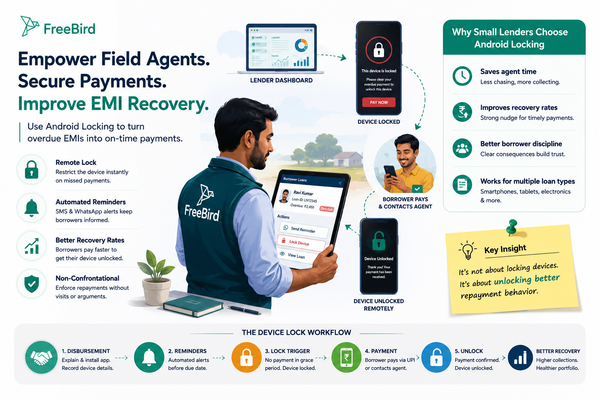
If you're financing Android smartphones or consumer durables, this is the feature that changes your collections math. An optional device-locking mechanism that remotely restricts a borrower's handset until an overdue EMI is cleared gives you a direct enforcement tool that no reminder can match.
This applies to Android devices only. It's not available on every plan, and it doesn't apply to iOS. But for mobile-shop finance operators and consumer durable lenders in India and East Africa, it's a meaningful differentiator.
Multi-Currency and Multi-Market Support
If you're operating across India and East Africa — or planning to expand — your software needs to handle multiple currencies without requiring a separate instance for each market. Some platforms still don't handle this cleanly.
Borrower-Facing App
A borrower app showing upcoming EMIs and payment history reduces inbound support queries and keeps borrowers engaged with their repayment schedule. Small feature, real operational impact.
The Gap in the Market: 50 to 500 Active Loans
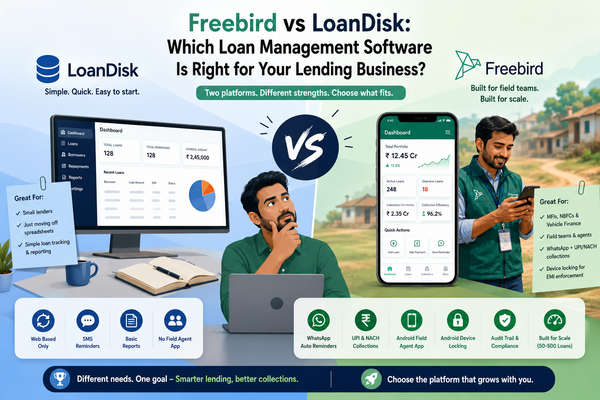
The segment most consumer lending software ignores is the 50 to 500 active loan range. Too large for a basic bookkeeping app. Too small for enterprise software.
This is where most MFIs and small NBFCs actually operate. And it's where the combination of WhatsApp automation, field agent management, compliance-friendly reporting, and affordable pricing matters most.
Freebird is built specifically for this segment. Three pricing tiers — Lite (up to 50 active loans), Professional (up to 500 active loans), and Team (unlimited active loans) — let you match your subscription to your current loan book. Month-to-month billing means no lock-in. A 7-day free trial with no credit card required means you can test it with real data before committing.
Exact pricing varies by region and features enabled, so that conversation happens during a demo rather than on a public pricing page. That's standard for this category.
What to Avoid When Evaluating Platforms
A few patterns to watch for when you're shortlisting:
- No mobile app for field agents. If your collections happen in the field, a web-only platform creates friction at every step.
- Freemium apps with no compliance reporting. A free mobile app is fine for tracking 20 borrowers. It's not sufficient when you need audit-trail-enabled records for regulatory purposes.
- Multi-month implementation timelines. If a vendor quotes months to get you live, that platform was not designed for your scale.
- Annual-only contracts. Month-to-month billing is standard for small-lender SaaS. Annual-only pricing at this tier is a red flag.
FAQs
What is consumer lending software and who is it for?
Consumer lending software helps lenders track loans, manage borrowers, automate payment reminders, and collect repayments. It's used by MFIs, NBFCs, vehicle finance companies, and individual lenders. The term covers everything from basic bookkeeping apps to enterprise loan servicing platforms — which is why matching the product to your scale matters.
How much does consumer lending software cost for small MFIs and NBFCs in 2026?
Pricing varies widely. Enterprise platforms like LoanPro are priced at $20,000 to $50,000 or more annually — inaccessible for most small lenders. Platforms built for MFIs and small NBFCs typically use tiered SaaS pricing based on active loan count, with month-to-month billing. Exact prices depend on the vendor, region, and features enabled.
What features should an MFI or NBFC look for in lending software?
Core requirements include loan and borrower tracking, automated SMS and WhatsApp payment reminders, UPI or auto-debit collection integrations, a field agent mobile app, compliance-friendly audit trails, and cash flow visibility. For consumer durable and mobile-phone finance operators, Android device locking is an additional capability worth evaluating.
Does consumer lending software support WhatsApp payment reminders?
Not all platforms do. WhatsApp-native automation is specific to platforms built for markets where WhatsApp is the primary communication channel — including India and East Africa. Enterprise US-focused platforms typically don't include this capability.
What is Android device locking in consumer lending software?
It's an optional feature that remotely restricts a borrower's Android handset until an overdue EMI is cleared. It applies to Android devices only and is primarily used by mobile-shop and consumer durable finance operators. Not all lending platforms offer it, and it is not available for iOS devices.
Can small NBFCs use the same software as large MFIs?
Yes, if the platform is designed to scale. Look for tiered pricing based on active loan count so you're not overpaying for capacity you don't need. Platforms with Lite, Professional, and Team tiers let you start small and grow your subscription as your loan book expands.
How long does it take to get started with lending software?
Platforms built for small lenders should have you operational within days, not months. If a vendor quotes a multi-month implementation timeline, that platform was designed for large institutions. A 7-day free trial with no credit card required is a reasonable standard to expect before committing.
Start This Week, Not Next Quarter
The right consumer lending software for your MFI or NBFC in 2026 is not the most expensive platform on the market. It's the one that matches your loan book size, supports your field operations, automates the reminders your team is currently sending manually, and produces the compliance records your regulator expects.
If you're managing between 50 and 500 active loans and haven't found a clear fit yet, Freebird is worth a look. No credit card, no long-term commitment — just your borrower data and a week to see whether it works for your operation.