Loan Management Software Features: The 12 Non-Negotiables Every Lender Should Check in 2026
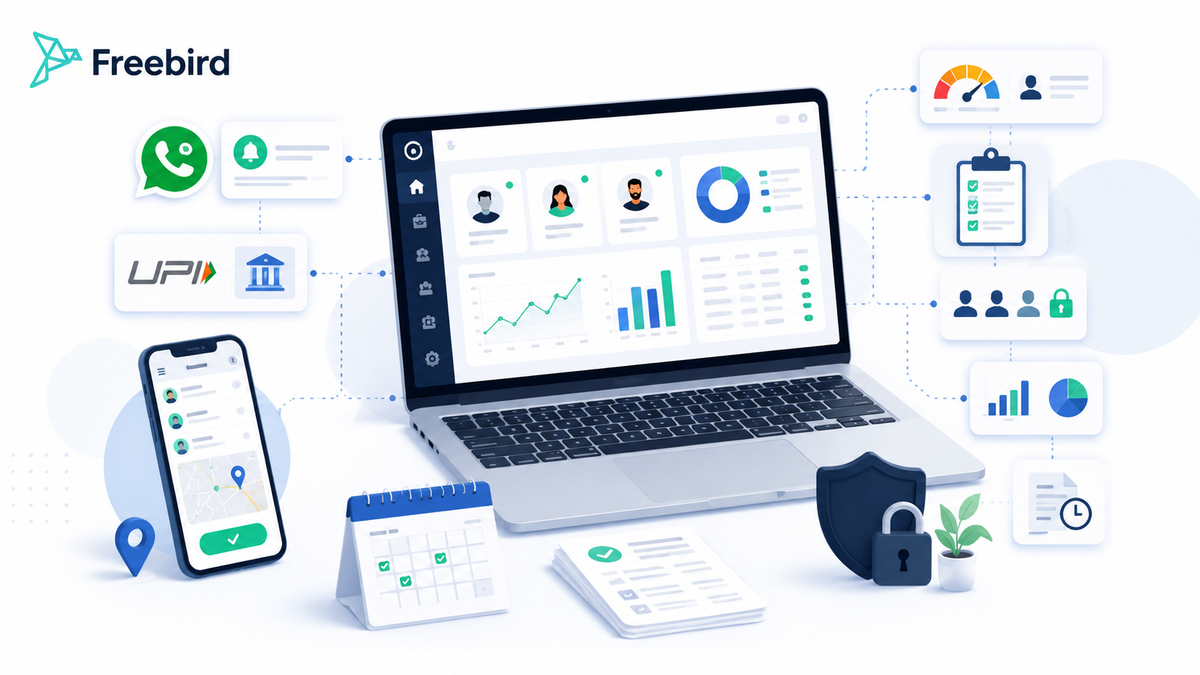
Choosing loan management software is one of the more consequential decisions you will make as a lender. Get it wrong and you are stuck with a platform that slows down your field agents, drops repayments through the cracks, and leaves your compliance team working blind. Get it right and collections largely run themselves, borrowers get timely reminders, and your team spends far less time on manual work.
This checklist is built for MFIs, vehicle finance companies, and small NBFCs — particularly those in the 50-to-500 borrower range. It covers the 12 features that actually separate capable platforms from ones that look polished in a demo but fall apart in the field. Use it to pressure-test any vendor before you sign anything.
Why a Feature Checklist Beats a Sales Demo
A demo shows you the best-case scenario, carefully prepared. A checklist forces the vendor to prove things work the way they claim. For lenders operating in the field, in low-connectivity areas, or in markets like India and Africa where WhatsApp is the dominant communication channel, the gap between "we support that" and "here is how it actually works" can be enormous.
None of the 12 features below are nice-to-haves. They are the minimum bar for any loan management software worth deploying in 2026.
The 12 Non-Negotiable Loan Management Software Features
1. Automated EMI Reminders via WhatsApp
SMS open rates are falling. WhatsApp messages get read. Any serious loan management platform for MFIs and NBFCs needs native WhatsApp automation built into the core product — not a third-party integration bolted on as an afterthought.
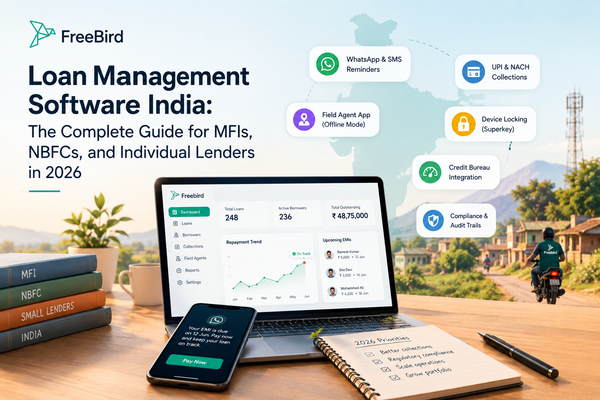
What to look for: automated pre-due reminders, overdue nudges, and repayment confirmations sent through WhatsApp without anyone on your team having to trigger them manually. Freebird includes WhatsApp-native automation as a core feature, not an optional add-on.
2. UPI and NACH Auto-Mandate Collection
Manual collection is expensive, inconsistent, and easy to dispute. UPI and NACH mandates let you pull repayments directly from a borrower's account on the due date, without chasing anyone.
For India-based lenders, this is non-negotiable. Ask the vendor whether UPI mandates and NACH auto-debits are live in their platform today or sitting on a roadmap. Freebird supports both for Indian lenders.
3. Android Field Agent App with Offline Mode
Your agents are not always in range. A field app that requires a live internet connection is effectively useless in rural areas or low-signal zones — which is exactly where many MFI borrowers are.
The right platform gives agents an Android app that works offline, syncs when connectivity returns, and lets them record collections, capture photos, and update loan status without waiting for a signal. This is one of the features that makes Freebird genuinely mobile-first rather than just mobile-friendly.
4. Device Locking for Secured Asset Finance (Superkey)
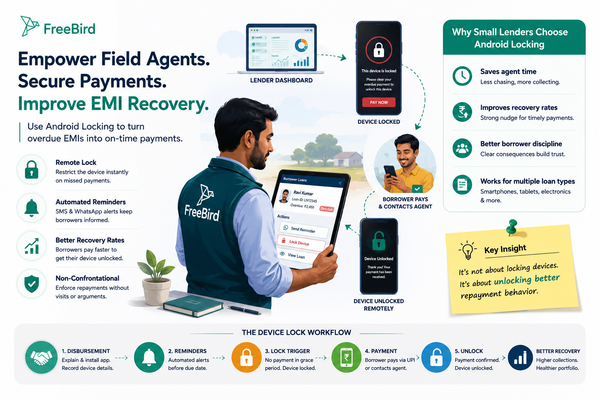
This one is rare. If you are running vehicle finance or any form of asset-backed lending, the ability to remotely disable a borrower's Android device or vehicle controller when a payment is missed is a meaningful collections lever — and a non-confrontational one.
Freebird's Superkey feature does exactly this, and it is available for lenders in India and Africa. Very few platforms offer this capability at all, let alone as a built-in feature rather than a custom integration. If you are a VFC or asset lender, ask every vendor directly whether they have it.
5. Loan Origination and Disbursement Workflow
A loan management system that only handles repayments is half a product. You need origination built in: application capture, document upload, credit assessment, approval workflow, and disbursement tracking — all in one place.
Check whether the platform supports configurable approval stages or whether you are expected to manage origination in a spreadsheet and import data manually. The latter is a warning sign.
6. Credit Bureau Integration
For Indian lenders, pulling a CIBIL or bureau report before disbursement is a compliance requirement, not a preference. The software should handle bureau checks natively, with results stored directly against the borrower record.
Freebird includes credit bureau integration for Indian lenders. If you are evaluating other platforms, confirm whether this is live or whether it requires a separate subscription and a manual workflow on your end.
7. Repayment Schedule Flexibility
Not all borrowers repay on the same cadence. MFIs often run weekly or fortnightly cycles. NBFCs typically work with monthly EMIs. Vehicle finance companies sometimes use irregular schedules tied to seasonal income patterns.
Your platform needs to handle multiple repayment frequencies without requiring custom development each time. A simple way to test this in a demo: set up a non-standard schedule and watch how the system responds.
8. Audit-Trail Enabled Transaction Logs
Every payment, waiver, restructure, and status change should be logged with a timestamp and the name of the user who made it. This is not just good housekeeping — it protects you during audits and borrower disputes.
Ask the vendor directly: can I see a complete history of every action taken on a loan, including who did it and when? A vague answer is a red flag.
9. Role-Based Access Control
A field agent should not have access to the same data as a finance manager. A branch head should not be able to delete loan records. Role-based access keeps your data secure and your operations clean.
Look for granular permission settings — not just broad "admin" and "user" buckets that give people more access than they need.
10. Portfolio Dashboard and Reporting
You need a clear view of your portfolio without exporting to Excel every morning: total outstanding, overdue buckets, collection efficiency, agent performance, and PAR by cohort — visible in real time.
Ask for a live demo of the reporting screen, not a screenshot. If the vendor hesitates, that tells you something.
11. Borrower Communication History
When a borrower calls to dispute a payment, your team should be able to pull up every message, reminder, and call log tied to that account within seconds. This matters especially if you are using WhatsApp automation, because the conversation history needs to be visible inside the platform — not sitting in a separate tool.
Platforms that store communication logs outside the core system create blind spots for both collections and compliance.
12. Scalable Pricing for Small Portfolios
Most enterprise loan management software is priced for lenders with thousands of borrowers. If you are running 50 to 500 active loans, you should not be paying enterprise rates for features you will never use.
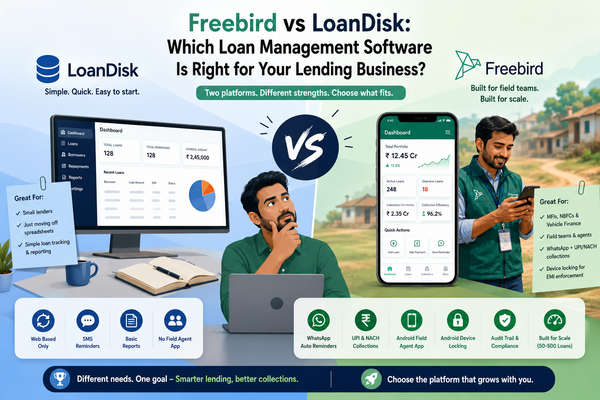
This is one of the clearest differentiators for Freebird. It is built specifically for MFIs, VFCs, and small NBFCs that need the same quality as platforms like Lendsqr or LoanDisk but at a price point that fits a smaller portfolio. WhatsApp automation, the offline field agent app, Superkey, UPI and NACH collection, and bureau integration — without the overhead of a 50,000-borrower pricing model.
How to Use This Checklist
Copy it into a spreadsheet and score each vendor: 0 for not available, 1 for on the roadmap, 2 for live and working. Any platform scoring below 18 out of 24 deserves a hard conversation before you go further.
Pay particular attention to features 1, 3, and 4. WhatsApp automation, offline field agent support, and device locking are the features most commonly missing from cheaper platforms — and most commonly underbuilt in enterprise ones.
A Note on Microfinance Loan Management Software
MFIs have specific requirements that general-purpose lending software tends to miss. Group lending workflows, joint liability tracking, centre meeting schedules, and weekly collection cycles are not standard in most platforms.
If you are an MFI, add these to your checklist alongside the 12 above. Ask specifically how the platform handles group loan disbursements and whether field agents can record group attendance and collections in the offline app.
Frequently Asked Questions
What are the most important loan management software features for small NBFCs?
The highest-priority features for small NBFCs are automated repayment collection via UPI and NACH, WhatsApp-based borrower communication, audit-trail enabled transaction logs, and role-based access control. Credit bureau integration is also essential for Indian NBFCs to stay compliant during origination.
Does loan management software need to work offline for field agents?
Yes, if your agents operate in areas with poor connectivity. An offline-capable Android app that syncs when internet is available prevents data loss and keeps field collections running without interruption. This is a standard requirement for MFIs and rural lenders.
What is device locking in the context of EMI collection software?
Device locking — called Superkey in Freebird's platform — allows a lender to remotely disable a borrower's Android device when a payment is overdue. It is used primarily by vehicle finance companies and asset-backed lenders in India and Africa as a non-confrontational collections tool.
How does WhatsApp loan collection automation work?
The loan management software connects to WhatsApp's business API and sends automated messages to borrowers before and after their due date — payment reminders, overdue notices, and confirmation messages once a payment is received. The best implementations keep the full conversation log visible inside the loan management platform itself.
Is microfinance loan management software different from standard loan software?
Yes. Microfinance software needs to support group lending structures, weekly or fortnightly repayment cycles, centre meeting tracking, and high-volume small-ticket loans. General-purpose loan software often handles individual term loans well but struggles with MFI-specific workflows without significant customisation.
How do I evaluate loan management software before committing?
Use a feature checklist like this one and ask the vendor to demonstrate each item live — not in a pre-recorded video. Pay attention to how they handle edge cases: offline collection, failed NACH mandates, and overdue escalation workflows. Request a trial with real data if possible.
What should lenders with 50 to 500 borrowers look for in pricing?
Look for per-borrower or portfolio-based pricing rather than flat enterprise fees. Platforms built for large lenders often charge for features you will never use. Freebird is designed specifically for lenders in this range — full-featured loan management software without the enterprise price tag.
What to Do Next
Run this checklist against every platform you are evaluating. If a vendor cannot demonstrate a feature live, treat it as unavailable.
If you are looking for a platform that checks all 12 boxes — WhatsApp automation, offline field agent support, Superkey device locking, and UPI and NACH collection — learn more at usefreebird.com.