Best Microfinance Software for Uganda (2026): Complete Guide for MFIs, SACCOs, and Money Lenders
You're managing 150 active loans out of a notebook or a shared spreadsheet. Repayment dates are tracked manually. Your field agents call borrowers from personal phones. And every month, reconciling collections eats two days you don't have.
That's the reality for most MFIs, SACCOs, and licensed money lenders in Uganda right now. The loan book is growing. The tools haven't kept up.
This guide covers what to look for in microfinance software built for the Uganda market, how local and global options compare, and where Freebird fits in that picture.
Why Spreadsheets Break Down Past 100 Loans
A spreadsheet works fine at 30 borrowers. You know most of them personally. Repayments come in through mobile money, you update the sheet, and it's uncomfortable but functional.
Past 100 loans, that system starts failing in specific ways.
You can't see which borrowers are overdue at a glance. You can't send payment reminders without doing it one by one. Your field agents are working off printed lists that go stale the moment someone pays. And when UMRA or an internal audit asks for a repayment history on a specific loan, you're piecing it together from three different files.
The problem isn't discipline. Spreadsheets simply weren't built for loan portfolio management. They have no concept of a repayment schedule, no way to flag overdue accounts automatically, and no audit trail that holds up under scrutiny.
When you're managing 200 or 500 active loans, you need software that treats each loan as a live record — not a row in a table.
The Uganda Compliance Context You Can't Ignore
If you're operating as a Tier 4 institution or licensed money lender, you're subject to the Tier 4 Microfinance Institutions and Money Lenders Act and the oversight of UMRA.
Legal Notice No. 21 of 2024 introduced a hard cap on interest rates: 2.8% per month, or 33.6% annually. That's not just a pricing constraint. It's a reporting requirement. Your loan management system needs to calculate interest correctly, document it accurately, and produce records that match what you've disclosed to borrowers.
If your software can't generate a clear repayment schedule, show the interest applied per cycle, and produce an audit trail per loan, you're carrying compliance risk every month.
That's one of the clearest reasons to move off spreadsheets. A compliance-ready loan management system handles this automatically — so you're not reconstructing records when UMRA comes asking.
What to Look for in Microfinance Software for Uganda
Not every loan management platform is built for how lending actually works here. Here's what matters in the Uganda context specifically.
Mobile Money and WhatsApp Support
Your borrowers don't use bank transfers. They pay via MTN Mobile Money or Airtel Money. Your software needs to reconcile those payments — or at least make them easy to log without a separate step.
WhatsApp is how your borrowers communicate. A system that sends automated payment reminders via WhatsApp, not just SMS or email, will get better response rates. That's not a nice-to-have in Uganda. It's how people actually operate.
An Android Field Agent App That Works Offline
Your field agents are collecting in areas with unreliable internet. They need to log visits, record payments, and update loan statuses from their phones — even when there's no data connection. The app should sync when connectivity returns.
A field agent app also removes the "I'll update it later" problem. When agents record collections on paper and transcribe them at the end of the day, errors happen. Real-time logging, even offline, closes that gap.
Compliance and Audit Trail for UMRA Reporting
Every loan should have a documented history: disbursement date, interest applied, repayments received, outstanding balance. That history should be exportable and readable by someone who didn't create it.
If you're ever reviewed by UMRA or need to produce records for a dispute, you want that trail to exist automatically — not because someone remembered to update a spreadsheet.
Device Locking for Collections Enforcement
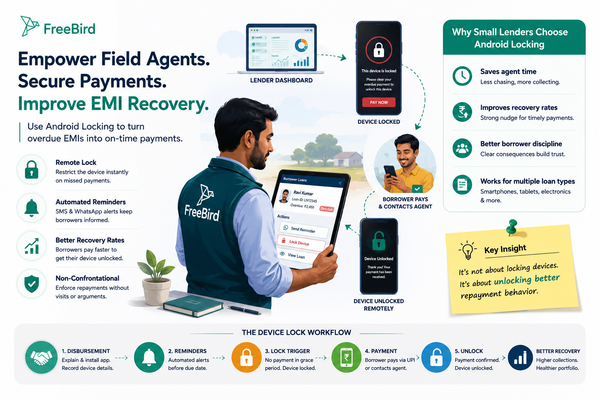
This one is specific to certain lending models. If your institution disburses loans tied to a borrower's Android phone, device locking (sometimes called SuperKey) lets you remotely restrict the phone's functionality until a repayment is made.
It's a collections tool, not a punishment mechanism. Used correctly, it changes the repayment dynamic on high-risk loans. It's particularly relevant for lenders across Uganda and East Africa where phone-linked lending is common.
Not every MFI needs this feature. But if your collections model depends on it, your software needs to support it natively.
How the Options Compare
There are a few categories of software you'll encounter when evaluating options for your Uganda operation.
Local Uganda-Built Tools
Ssentezo is a Uganda-native platform that some MFIs and SACCOs use. It understands the local market and has been built with Ugandan lending workflows in mind. If your needs are straightforward and you want a locally supported product, it's worth evaluating.
The tradeoff is typically feature depth and scalability. Local tools often handle the basics well but may not support WhatsApp automation, offline-capable field agent apps, or device locking at the same level as platforms built specifically around those features.
Generic International Platforms
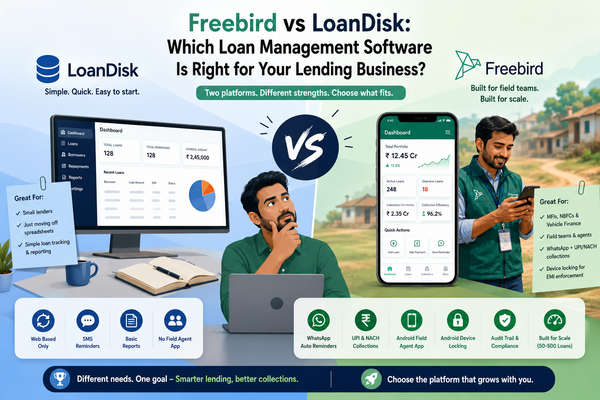
Platforms like LoanDisk are used by small lenders globally and offer solid loan tracking. They're more capable than spreadsheets and handle repayment schedules, interest calculations, and basic reporting.
The gap tends to show up in mobile-first features. If your operation depends on field agents with Android phones and WhatsApp-based borrower communication, a platform built primarily for desktop-based loan officers in a different market may not fit your workflow.
Freebird
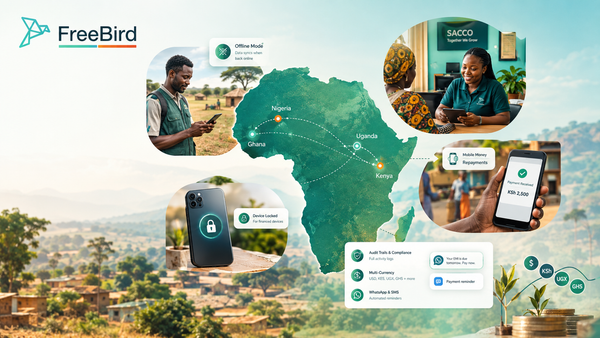
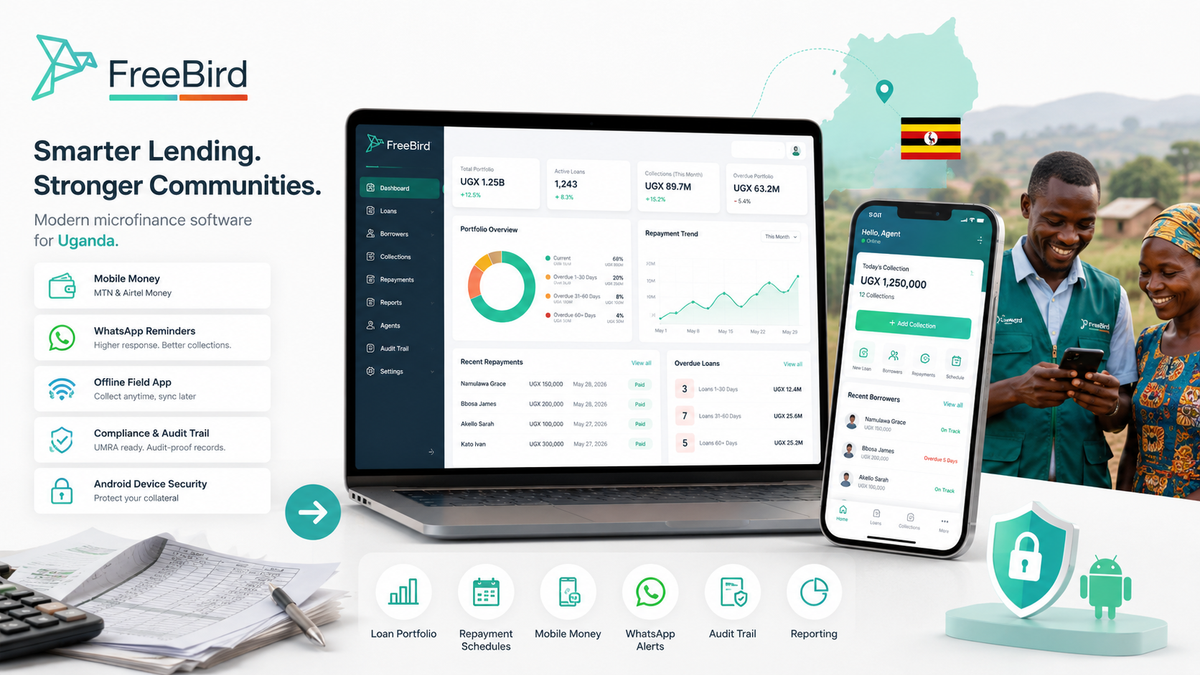
Freebird was built for exactly the kind of operation most Ugandan MFIs run: mobile-first, field-agent-dependent, WhatsApp-heavy, and growing past the point where spreadsheets hold up.
A few things directly relevant to the Uganda market:
- WhatsApp-native automation: Payment reminders, overdue notices, and borrower communication go out via WhatsApp automatically. You set the schedule; Freebird handles the sending.
- Android field agent app with offline mode: Your agents log collections and borrower visits from their phones. The app works without internet and syncs when connectivity returns.
- SuperKey device locking: For lenders using phone-linked loan products, Freebird supports remote Android device locking as a collections enforcement tool. Available for Africa-based operations.
- Audit-trail enabled records: Every loan has a documented history. Interest calculations, repayment logs, and outstanding balances are tracked automatically — which supports UMRA reporting requirements.
- Accessible pricing for growing MFIs: Freebird is built for institutions managing 50 to 500+ borrowers, not enterprise banks. The pricing reflects that. For specifics, the team walks you through it in a demo.
There's no large IT setup required. You can get your borrower list imported and your first payment reminders going within days.
Freebird vs the Alternatives: A Practical Summary
| What You Need | Spreadsheets | Local Tools (e.g. Ssentezo) | Generic International LMS | Freebird |
|---|---|---|---|---|
| Repayment schedule tracking | Manual | Yes | Yes | Yes |
| WhatsApp automation | No | Limited | Limited | Yes (native) |
| Offline Android field agent app | No | Varies | Rarely | Yes |
| Device locking (SuperKey) | No | No | No | Yes (Africa) |
| Audit trail for UMRA compliance | No | Partial | Partial | Yes |
| Accessible pricing for 50–500 loans | Free but fragile | Varies | Moderate | Yes |
The Right Time to Switch Is Before You Need To
Most MFIs switch software after a crisis: a collections dispute, a UMRA query they couldn't answer cleanly, or a field agent who left and took the repayment records with them.
You don't have to wait for that. If your loan book is past 100 active loans and you're still on spreadsheets or a basic tool, the cost of switching now is lower than the cost of fixing problems later.
Freebird is worth a conversation if you're managing 50 to 1,000+ active loans in Uganda and want a system that handles WhatsApp reminders, field agent tracking, and compliance-ready records — without enterprise-level complexity or pricing.
Book a demo at usefreebird.com and see how it fits your operation.
Frequently Asked Questions
Is Freebird suitable for SACCOs in Uganda?
Yes. Freebird works for SACCOs, MFIs, and licensed money lenders managing active loan portfolios. If you're tracking repayments, managing field agents, and need audit-trail documentation, the platform fits that workflow.
Does Freebird support mobile money reconciliation for MTN or Airtel Money?
Freebird supports mobile-first loan management and WhatsApp-based payment workflows. For specific mobile money integration details relevant to your Uganda operation, the best step is to walk through your setup during a demo at usefreebird.com.
What is the 2.8% interest rate cap and how does it affect my software choice?
Legal Notice No. 21 of 2024 under the Tier 4 Microfinance Institutions and Money Lenders Act caps interest at 2.8% per month (33.6% annually) for licensed lenders in Uganda. Your loan management software needs to calculate and document interest accurately to stay compliant. A system with built-in audit trails makes that straightforward.
What is SuperKey device locking and do I need it?
SuperKey lets lenders remotely restrict an Android phone's functionality when a borrower misses a repayment. It's relevant for lenders using phone-linked loan products. Not every MFI needs it — but if your collections model depends on this kind of enforcement, Freebird supports it natively for Africa-based operations.
How long does it take to get started with Freebird?
You can import your borrower list and start sending automated payment reminders within days, not months. No large IT setup required.
How does Freebird compare to Ssentezo for Uganda-based MFIs?
Ssentezo is a locally built option with Uganda-specific context. Freebird brings deeper feature coverage in WhatsApp automation, offline Android field agent tools, and device locking. The right choice depends on your operation's size, workflow, and which features matter most. Both are worth evaluating.
Does Freebird work for lenders managing fewer than 100 borrowers?
Yes. Freebird is built for institutions managing 50 to 500+ active loans. If you're approaching 100 borrowers and already feeling the strain of manual tracking, it's a good time to switch before the problems compound.