Why Month-to-Month Billing Matters for Small Lenders Choosing Loan Software in 2026
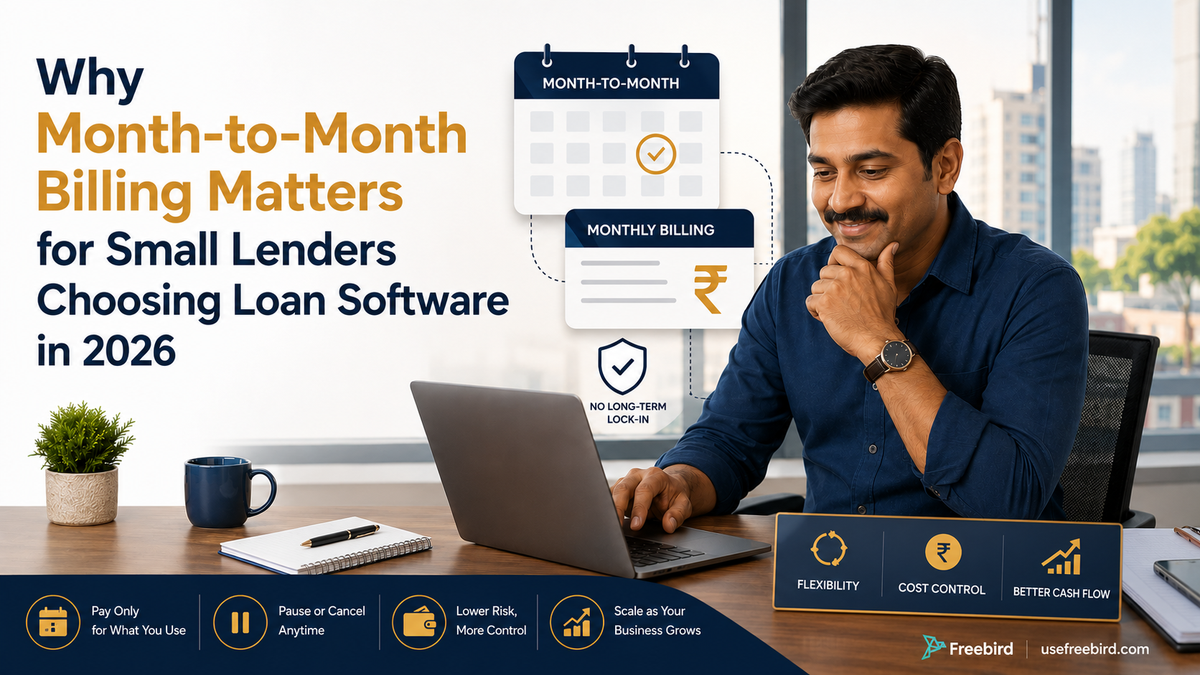
Most loan software vendors want you to sign a 12-month contract before you've seen the product handle a single real repayment. That's a serious problem when you're managing 100 borrowers, not 100,000.
For small MFIs (microfinance institutions), NBFCs (non-banking financial companies), and individual lenders, the commitment risk often outweighs the software cost itself. A year-long contract locks you into a platform even if it turns out to be too complex, poorly supported, or simply not built for how your team works. Month-to-month billing changes that calculation entirely.
This article covers why flexible billing matters, what to look for when evaluating loan software with no contract, and how to use a free trial to make a confident decision.
The Real Cost of Annual Contracts for Small Lenders
When a vendor asks you to commit upfront for a year, they're transferring risk onto you. If the product doesn't deliver, you're stuck. If your portfolio shrinks during a difficult quarter, you're still paying full price. If something better comes along six months in, switching costs are high.
Large NBFCs can absorb that kind of risk. A lender with 50,000 active loans and a dedicated IT team can negotiate contracts, run parallel systems, and manage a migration. A lender managing 200 borrowers cannot.
There's also a psychological cost that's separate from the financial one. Once you've paid for a year, you'll tolerate a mediocre product longer than you should — because switching feels like admitting a mistake. That inertia quietly costs you time and collection performance.
What Lenders Actually Need from Billing
Loan software billing should move with your portfolio, not against it. You might start with 40 active loans and reach 150 within six months. Or a large group loan temporarily inflates your active count before returning to normal. You need a billing structure that accommodates that kind of movement.
Month-to-month billing gives you three things annual contracts don't:
- The ability to stop if the product doesn't deliver — no penalty, no negotiation, no wasted months.
- The freedom to upgrade or downgrade as your active loan count changes.
- A real incentive for the vendor to keep earning your business every single month.
That last point is easy to overlook. A vendor on annual contracts has your money regardless of how well they support you. A vendor on month-to-month billing has to stay useful.
Why the 7-Day Free Trial Changes the Decision
A free trial is only valuable if it's long enough to test the product against real work. Seven days is enough to:
- Import or manually enter a sample of your active borrowers
- Set up automated SMS and WhatsApp payment reminders
- Run a test collection cycle and check what the dashboard shows
- Confirm your field agents can use the mobile app without hand-holding
- Export a report and check whether it matches what your compliance records actually need
If a platform can't prove its value within seven days of real use, that tells you something. Good loan software for small lenders should be operational within hours, not weeks.
The absence of a credit card requirement during the trial also matters. It signals the vendor isn't trying to slip you into billing before you've decided. It's a small thing, but it reflects how they think about the relationship.
What to Look for in Flexible Loan Software Pricing
Not all "month-to-month" offers are equal. Some vendors advertise monthly billing but require a three or six-month minimum. Others charge a significant premium for monthly billing over annual pricing, making the flexibility expensive in practice.
When evaluating loan software pricing, ask these specific questions:
Is month-to-month the standard billing cycle, or a premium add-on? If monthly billing costs significantly more than the annualised rate, you're paying extra for something that should be standard.
Are there cancellation fees or notice periods? Some contracts require 30 or 60 days' notice before cancellation, which effectively extends your commitment whether you want it to or not.
Can you change plans mid-cycle? If your active loan count crosses a tier threshold, you want to upgrade without waiting for a renewal date.
Is there a lifetime purchase option? For lenders who are confident in a platform, a one-time payment can be more cost-effective than ongoing monthly billing. Some platforms offer this, though it's less common.
How Freebird Handles Billing for Small Lenders
Freebird is built for lenders managing 10 to 1,000+ active loans, and its billing structure reflects that. Three plans cover up to 50 active loans (Lite), up to 500 (Professional), and unlimited (Team). All plans start with a 7-day free trial — no credit card required.
Billing is month-to-month with no long-term contracts. Exact pricing varies by region and the features you enable, so it's shared during a sales conversation rather than listed publicly. The structure is straightforward: you pay for the plan that fits your current active loan count, and you're never locked in.
A lifetime purchase option has also been confirmed by existing users, which makes Freebird one of the few loan management platforms where you can move off recurring billing entirely once you're confident the product works for your operation.
This matters because the lenders Freebird is built for — those who've outgrown spreadsheets but aren't ready to commit to enterprise software — have one consistent objection: what if it doesn't work for us? Month-to-month billing removes that objection directly.
The Commitment Risk Is Higher Than It Looks
Think about what annual contracts actually cost a small NBFC or MFI beyond the subscription fee.
You sign a 12-month contract. Three months in, you realise the platform doesn't support WhatsApp-native reminders, your field agents can't use the mobile app offline, or the compliance reports don't match your audit requirements. Now you have two options: keep paying for a platform you're not using, or pay to migrate while still under contract.
Neither is good. Both are avoidable.
The loan software category has historically been built for large institutions. Lendsqr and LoanDisk serve the mid-market well, but for a lender managing 50 to 500 borrowers — especially in India, Southeast Asia, or South Africa — the pricing and contract structures of enterprise platforms don't fit the operational reality. Month-to-month billing isn't just a pricing preference. It's a signal that a vendor understands who they're actually building for.
Making the Most of Your Free Trial
If a free trial is available, treat it like a real deployment — not a demo. Here's a practical approach for seven days:
Days 1–2: Set up your account, add 10 to 20 real borrowers, and configure your payment reminder schedule. Confirm that WhatsApp and SMS reminders send correctly.
Days 3–4: Test the collection workflow. Record one or two repayments manually and through auto-debit if your setup supports it. Check the dashboard for real-time updates.
Days 5–6: Add a field agent if you have one. Have them use the mobile app for a collection visit and check whether their activity appears in your dashboard.
Day 7: Export a report in PDF or Excel. Check whether the data is structured in a way that would hold up in a compliance review or audit.
If the platform passes those seven days, you have a strong basis for a decision. If it doesn't, you've lost nothing.
FAQs
What does month-to-month billing mean for loan software?
It means you pay one month at a time, with no annual contract or long-term commitment. You can cancel, upgrade, or downgrade without penalties. For small lenders, this removes the financial risk of committing to a platform before you know it works for your operation.
Is a 7-day free trial enough time to evaluate loan management software?
For most small MFIs and NBFCs, yes. Seven days is enough to test borrower management, automated reminders, collection workflows, field agent tools, and report exports. If a platform can't demonstrate clear value in seven days of real use, that's useful information in itself.
Why do some loan software vendors require annual contracts?
Annual contracts are common in enterprise software because they provide predictable revenue for the vendor and often come with lower per-month pricing. For large institutions with IT teams and multi-month implementation timelines, that structure makes sense. For lenders managing 50 to 500 loans, it transfers too much risk to the buyer.
Can I switch loan software plans if my active loan count changes?
On flexible platforms, yes. Look for software that lets you upgrade or downgrade between plans without waiting for a renewal date — especially important if your portfolio grows quickly or fluctuates seasonally.
What is a lifetime purchase option for loan software?
A one-time payment that gives you permanent access to the software without ongoing monthly billing. It's less common than subscription pricing but can be cost-effective for lenders who are confident in a platform and want to eliminate recurring costs.
What should I test during a loan software free trial?
Focus on the workflows that matter most day-to-day: borrower setup, payment reminders, collection recording, field agent coordination, and report exports. Test with real data where possible. The goal is to confirm the platform handles your actual loan volume and communication preferences before you commit.
Does Freebird offer month-to-month billing with no contract?
Yes. Freebird bills month-to-month with no long-term contracts across all three plans. A 7-day free trial is available with no credit card required. A lifetime purchase option has also been confirmed by existing users for lenders who prefer to move off recurring billing altogether.
The Decision Is Simpler Than It Looks
Choosing loan software doesn't have to be a drawn-out evaluation. If a platform offers a genuine free trial, month-to-month billing, and no cancellation penalties, the risk of trying it is close to zero.
The real question isn't whether you can afford to try flexible loan software. It's whether you can afford to keep managing your portfolio without it.
Request a live demo at usefreebird.com to see how Freebird works for your specific loan count and borrower mix.
See what our customers say about Freebird on G2 → https://www.g2.com/products/tilicho-fintech-freebird/reviews