Microfinance Software India: The Complete 2026 Guide

India's microfinance sector manages over 5.5 crore (55 million) active borrowers and a portfolio outstanding of roughly Rs 2,77,000 crore. Behind every one of those loans sits a repayment schedule, a field agent, a compliance obligation, and — for most small lenders — a spreadsheet that is quietly buckling under the weight of it all.
This guide covers what microfinance software actually does, who needs it, which capabilities matter, what RBI (Reserve Bank of India) and MFIN (Microfinance Institutions Network) expect from your operations in 2026, and how to choose a platform that fits a sub-2,000-borrower portfolio without paying for enterprise features you will never use.
What Microfinance Software Does
Microfinance software is loan management software built for the operational reality of small lending: field disbursements, group loans, weekly or fortnightly EMI (equated monthly instalment) cycles, borrowers without reliable internet access, and regulators who want clean audit trails.
At its core, it replaces the spreadsheet-and-manual-WhatsApp-reminder workflow with a system that tracks every loan, every repayment, and every borrower interaction in one place. The best platforms go further — automating borrower communication, giving field agents a mobile app that works offline, and generating compliance reports your auditors can actually use without a week of data cleanup first.
Who Needs It
The range is wider than most people expect.
Solo lenders and village finance companies (VFCs) managing 10 to 100 borrowers are the most underserved segment. They typically run on WhatsApp groups and Excel. A missed collection hits hard relative to portfolio size, but enterprise software is priced for institutions ten times their scale.
Microfinance institutions (MFIs) managing 100 to 2,000 borrowers are the core market. They have field agents, compliance obligations, and repayment rates that depend on consistent follow-up. A bad repayment month — or a compliance circular from RBI — is usually what finally pushes them off spreadsheets.
Small NBFCs (non-banking financial companies) with 500 to 5,000 active borrowers need everything an MFI needs, plus credit bureau reporting, NACH (National Automated Clearing House) auto-debit mandates, and audit-trail documentation that holds up under RBI inspection.
Consumer EMI lenders — particularly electronics and appliance financiers — have a specific need: repayment enforcement on financed devices. Android device locking, which remotely restricts a borrower's phone until an overdue EMI is cleared, is purpose-built for this segment.
If you are evaluating platforms for a specific segment, [Best Loan Management Software for Microfinance Institutions in 2026] and [Best Loan Management Software for NBFCs in India 2026: Features, Compliance, and Pricing Compared] go deeper on shortlists and feature comparisons for each.
Core Capabilities to Evaluate
Not every feature matters equally. These are the ones that separate a genuinely useful platform from a glorified database.
Automated Borrower Communication
Manual WhatsApp reminders are the single biggest time drain for small lending teams. A platform with WhatsApp-native automation sends payment reminders before due dates, overdue notices after them, and confirmation receipts when payment clears — without anyone on your team touching a phone.
SMS fallback matters too. Borrowers in tier-2 and tier-3 markets are not always on WhatsApp. A good platform handles both channels from the same workflow, not as separate integrations bolted on after the fact.
Field Agent App
If your collections happen in the field, a browser-based dashboard is not enough. Your agents need a mobile app — Android, specifically, given device distribution across India — that works in low-connectivity environments, logs collections in real time, and syncs when connectivity returns.
This is not a nice-to-have. Missed collections almost always trace back to agents working from memory or paper, with no system to flag gaps until end of day.
Compliance Reporting and Audit Trails
Every borrower interaction, every repayment, every agent activity should be logged automatically. When an RBI inspection or internal audit arrives, you should be able to pull a clean report in minutes — not spend a week reconstructing records from WhatsApp threads and spreadsheets.
The [NBFC-MFI Compliance Checklist 2026 – RBI Requirements] article covers the specific documentation standards in detail.
Android Device Locking
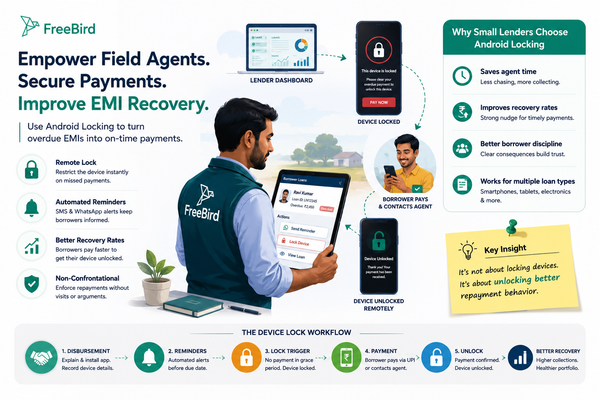
For consumer EMI lenders, this feature changes the repayment dynamic entirely. When a borrower's financed Android device is remotely locked until the overdue EMI clears, the incentive to pay is immediate and concrete. No phone calls. No field visits for a single missed payment.
This capability exists in only a small number of platforms globally. If your portfolio includes financed smartphones or tablets, it belongs on your evaluation checklist. The Android device-lock content on the site goes deeper on how this works in practice.
UPI and NACH Auto-Debit
For India-based lenders, UPI (Unified Payments Interface) collection and NACH auto-debit mandates reduce repayment friction for borrowers and cut manual follow-up for your team. Real-time payment tracking means your dashboard reflects actual collections — not what agents reported at end of day.
Multi-Currency and Global Support
If you operate across India and East Africa, or plan to, you need a platform that handles multi-currency portfolios without separate instances or manual currency conversion.
Compliance and RBI Requirements in 2026
RBI has tightened operational discipline expectations for both NBFCs and MFIs through 2025 and into 2026. The direction is clear: lenders need documented processes, clean borrower communication records, and audit-trail-enabled systems that can demonstrate compliance without reconstructing data after the fact.
MFIN's February 2026 Guidance Note reinforced several operational areas: borrower over-indebtedness assessment, transparent pricing disclosure, and systematic grievance redressal. Each of these requires a software layer — not just a policy document sitting in a folder.
Practically, your platform needs to:
- Log every borrower interaction with timestamps
- Generate repayment schedules and statements borrowers can access
- Support credit bureau reporting (CIBIL and equivalent) for India-based portfolios
- Maintain agent activity records that can be produced during an inspection
- Handle KYC (Know Your Customer) documentation in a structured, retrievable format
Platforms built for global markets without India-specific compliance workflows often fall short here. The [NBFC-MFI Compliance Checklist 2026 – RBI Requirements] article maps these requirements to specific software features if you want a more granular breakdown.
Sector Benchmarks: India and Global Context
India's microfinance market is large and growing — but also under pressure. The 5.5 crore borrower base and Rs 2,77,000 crore portfolio outstanding reflect a sector that has scaled significantly, and that scale brings operational complexity that spreadsheets simply cannot handle.
Globally, the loan management software market is expanding at pace. According to the Research and Markets Loan Management Software Market Report 2026, the market grew from USD 12 billion in 2025 to USD 14.13 billion in 2026, a 17.7% compound annual growth rate. That growth is driven by exactly the segment this guide addresses: small and mid-size lenders in emerging markets moving off manual processes.
The implication for Indian MFIs and NBFCs is straightforward. Software adoption is no longer a future consideration — it is already the baseline for lenders who want to compete on repayment rates and operational consistency. The question is which platform fits your scale and budget.
How to Choose Microfinance Software
Evaluation criteria depend on your portfolio size, team structure, and compliance obligations. Here is a practical framework.
Start with your biggest operational pain. If field agents are missing collections, the field agent app is your first filter. If your team spends hours on WhatsApp reminders, automation is the priority. If an RBI inspection is coming, audit-trail documentation moves to the top.
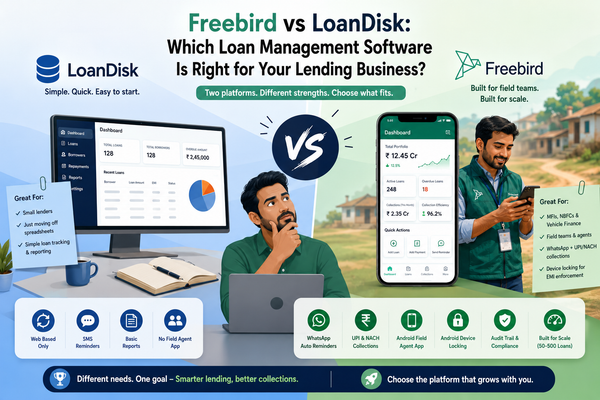
Match the platform to your borrower count. Enterprise platforms like LoanPro are priced for portfolios in the tens of thousands, with implementation timelines and IT requirements that do not fit a 200-borrower MFI. You need a platform built for your scale — not one you will spend five years growing into.
Check for India-specific integrations. UPI, NACH, and credit bureau connectivity are not optional for India-based lenders. A platform without these creates manual workarounds that cancel out the efficiency gains of leaving spreadsheets behind.
Evaluate the mobile experience. Your field agents are not sitting at desks. If the platform does not have a strong Android app with offline capability, it will not survive contact with actual field operations.
Understand the total cost. Monthly subscription pricing is easier to evaluate than annual contracts with implementation fees layered on top. Look for platforms that offer a free trial without requiring a credit card, so you can test real workflows before committing.
Ask about compliance support. A platform that generates audit-trail reports automatically is worth more than one that stores data but requires manual extraction. Ask vendors specifically how their system handles RBI inspection requests.
Where Freebird Fits
Freebird is built for the segment this guide describes: MFIs, VFCs, and small NBFCs managing between 50 and 2,000 active borrowers, operating in India or globally, who need more than a spreadsheet but cannot justify enterprise software costs.
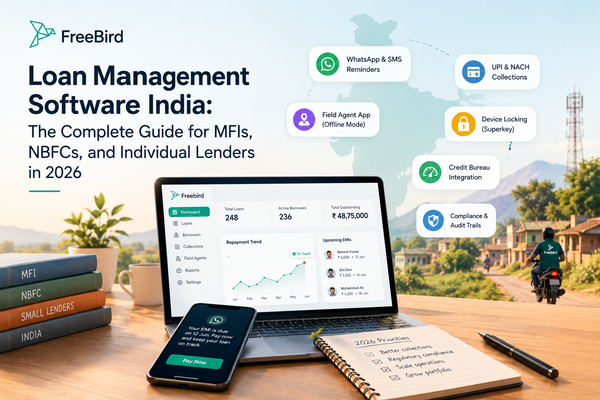
The platform combines WhatsApp-native borrower communication, an Android field agent app with offline capability, UPI and NACH auto-debit, credit bureau integration for India, and Superkey — the Android device-locking feature for consumer EMI lenders. AI calling is available in India as a pilot feature. Audit-trail-enabled reporting covers borrower interactions and agent activity in a format designed for RBI compliance reviews.
Three plan tiers cover portfolios from 50 active loans (Lite) to 500 (Professional) to unlimited (Team). A 7-day free trial requires no credit card. Month-to-month billing means no long-term contract commitment.
For lenders evaluating the sub-USD 3,000 per year segment, there is no clear incumbent with this combination of WhatsApp automation, field agent tooling, device locking, and India-specific compliance integrations. That gap is what Freebird is built to fill.
Ready to see how it works with your actual portfolio? Request a live demo at usefreebird.com.
Frequently Asked Questions
What is microfinance software and how is it different from general loan management software?
Microfinance software is loan management software designed for the operational patterns of small lenders: group loans, weekly or fortnightly EMI cycles, field-based disbursement and collection, and compliance requirements specific to MFIs and NBFCs. General loan management software often lacks field agent apps, WhatsApp automation, and the India-specific integrations — UPI, NACH, credit bureau — that MFIs and NBFCs depend on.
What RBI requirements should my microfinance software support in 2026?
Your platform should log every borrower interaction with timestamps, support credit bureau reporting, generate repayment schedules borrowers can access, maintain agent activity records, and handle KYC documentation in a retrievable format. MFIN's February 2026 Guidance Note also emphasises over-indebtedness assessment and transparent pricing disclosure — both of which require a software layer to document consistently.
Does microfinance software work for solo lenders or very small portfolios?
Yes. Platforms like Freebird offer plan tiers starting at 50 active loans, with a 7-day free trial and no credit card required. Solo lenders and VFCs managing 10 to 100 borrowers benefit from automated reminders and basic audit trails even at small scale.
What is Android device locking and which lenders need it?
Android device locking remotely restricts a borrower's financed Android phone until an overdue EMI is cleared. It is most relevant for consumer electronics and appliance lenders who finance devices directly. The feature is available in India and Africa and is currently unique among the platforms serving this market segment.
How important is WhatsApp automation for Indian MFIs?
Very important. Manual WhatsApp reminders are one of the two biggest time drains for small lending teams — the other being field collection follow-up. WhatsApp-native automation that sends reminders before due dates and overdue notices after them reduces staff hours spent on follow-up and improves repayment consistency without adding headcount.
What should I look for in a field agent app for microfinance collections?
The app should run on Android, work offline in low-connectivity environments, log collections in real time, and sync automatically when connectivity returns. It should also give your operations lead visibility into agent activity without waiting for end-of-day reports.
How much does microfinance software typically cost for a small MFI in India?
Pricing varies by platform and portfolio size. Enterprise platforms can run USD 20,000 or more annually and require dedicated IT teams. Platforms built for small MFIs and NBFCs managing 50 to 500 borrowers are priced significantly lower and typically offer month-to-month billing. Exact pricing for Freebird is shared during a sales conversation and varies by region and plan tier.