What Is Loan Management Software? A Plain-English Guide for Lenders in 2026
If you're managing loans on a spreadsheet right now, you already know where this is going. Payments arrive at odd hours, borrowers miss due dates, and your "system" is a tangle of tabs that only makes sense to you. One broken formula and your entire portfolio view is off.
Loan management software exists to replace that. This guide covers what it actually does, who needs it, what to look for, and how to evaluate free trials and affordable options in 2026 — without wading through enterprise sales decks built for banks.
What Loan Management Software Actually Does
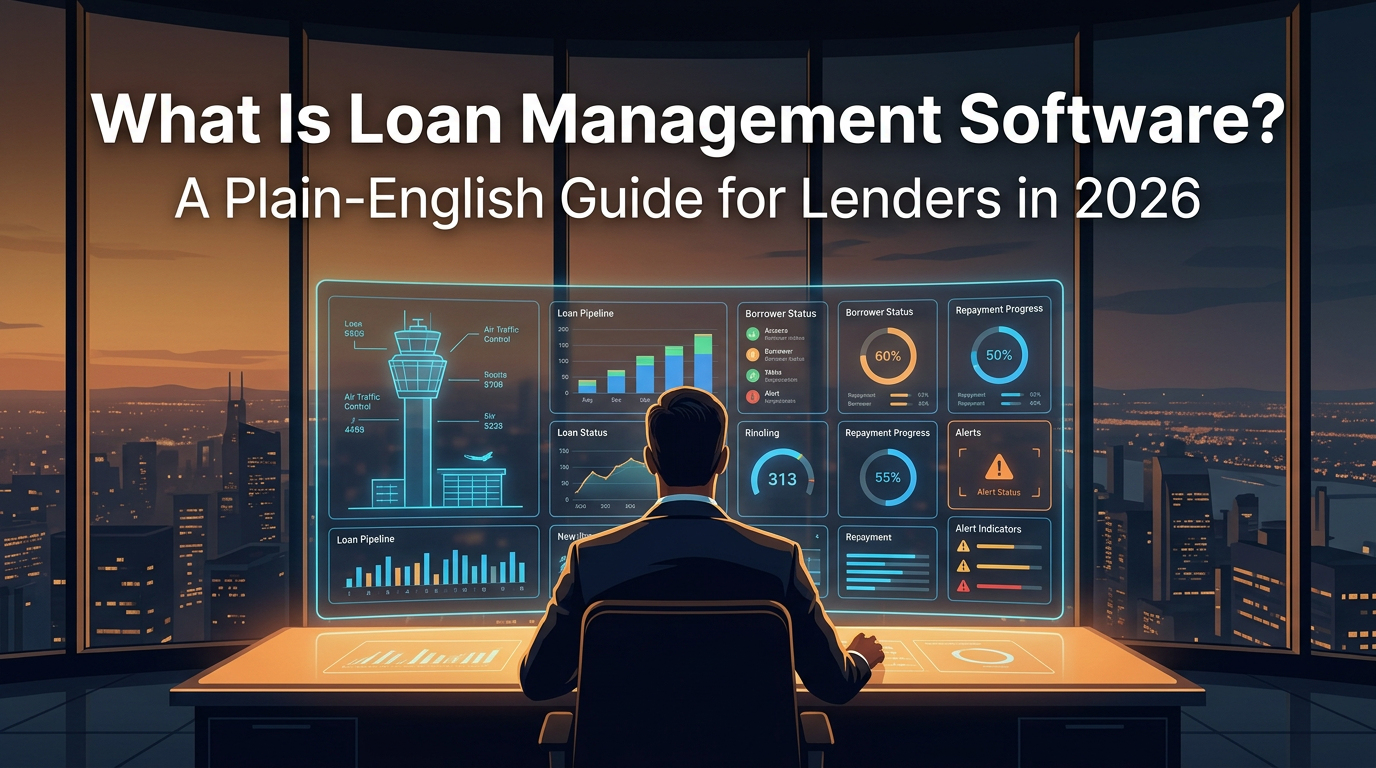
At its core, loan management software tracks every loan in your portfolio from disbursement to final repayment. That sounds straightforward, but the operational work it replaces is significant.
A proper system handles:
- Borrower records — contact details, loan terms, repayment history, and communication logs in one place
- EMI (equated monthly installment) schedules — auto-calculated and updated as payments come in or get missed
- Payment reminders — sent automatically via SMS or WhatsApp before due dates, not after a missed payment
- Collections — auto-debit mandates and UPI integrations that collect repayments without manual follow-up
- Reporting — cash flow dashboards, overdue summaries, and compliance-friendly exports in PDF or Excel
- Field agent coordination — assigning borrowers to agents and tracking their collection activity
Most lenders start feeling the strain somewhere between 30 and 80 active borrowers. Below that, a spreadsheet is manageable. Above it, the cracks show fast.
Who Uses Loan Management Software?
The category covers a wide range of lenders. What they share is that they operate outside traditional banks — individual money lenders, microfinance institutions (MFIs), or non-banking financial companies (NBFCs) that issue loans directly to individuals or small businesses.
In practice, that includes:
- Individual private lenders managing 20 to 100 borrowers, often in a single city or district
- Small MFIs running group lending programs with weekly or monthly collections
- NBFCs with 500 to 5,000 active borrowers who need formal audit trails and compliance reporting
- Consumer electronics retailers and mobile phone shops selling devices on EMI installment plans and managing — sometimes enforcing — repayments
Each of these has different priorities. A solo lender wants something simple that sends reminders and tracks who paid. A regulated NBFC needs borrower communication logs, compliance-friendly reports, and field agent management. A device retailer needs a way to lock a borrower's phone remotely if payments stop.
Good loan management software serves all of these without requiring a dedicated IT team to get it running.
The Real Cost of Not Using One
The most common objection is cost. But the actual cost of staying on spreadsheets is harder to see because it's spread across your week.
Most lending businesses spend 3 to 5 hours every week on manual payment follow-ups — calling borrowers, sending WhatsApp messages one by one, updating records after each conversation. That time compounds. At 100 borrowers, it's a part-time job. At 300, it's unsustainable.
Then there's default risk. When reminders go out late or inconsistently, borrowers start treating repayment as optional. A system that sends automated reminders three days before a due date — not three days after — changes borrower behavior without confrontation.
And if you're an NBFC or MFI operating under regulatory oversight, a spreadsheet has no audit trail. If your regulator asks for a communication log or repayment history, you're reconstructing it manually under pressure.
What to Look for in Loan Management Software
Not every platform is built for the same lender. Here's what actually matters when you're evaluating options.
Automated Reminders via WhatsApp and SMS
Your borrowers are on WhatsApp. A system that sends reminders through WhatsApp — not just email — actually gets read. Automated SMS as a backup covers borrowers on basic phones. Look for reminders that go out before the due date, not just after a missed payment.
Auto-Debit and UPI Integration
Manual collection is the biggest time drain in small lending operations. Auto-debit mandates and UPI integrations let repayments happen without you chasing anyone. In India, NACH (National Automated Clearing House) mandates and UPI are the two most practical collection rails for MFIs and NBFCs.
Field Agent Management
If you have agents collecting in the field, you need visibility into what they're doing. A good system assigns borrowers to agents, tracks collection activity, and works offline — because your agents aren't always in areas with reliable connectivity.
Compliance-Friendly Reporting
Borrower communication logs, repayment histories, and exportable reports mean that when an audit happens, you're not scrambling. For NBFCs and MFIs under RBI oversight or similar regulatory frameworks, this isn't optional.
Device Locking (for EMI Consumer Lenders)
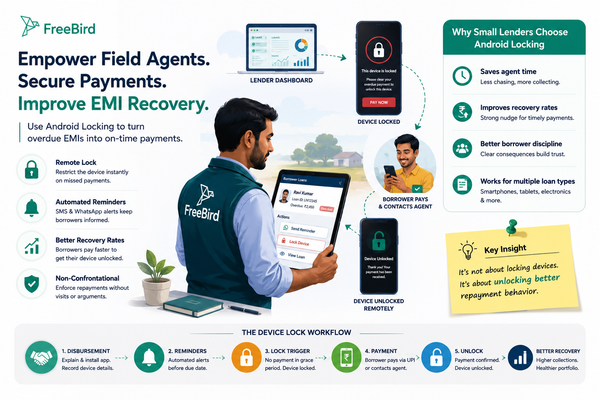
If you sell mobile phones or electronics on installment, this feature is worth understanding. Some platforms — including Freebird — offer an Android device-locking feature (called Superkey) that remotely restricts a borrower's phone until an overdue EMI is cleared. No competitor currently offers an equivalent. For consumer device lenders, it's the most direct loss-prevention tool available, and it works without a phone call or confrontation.
Pricing That Fits Your Portfolio Size
Enterprise loan management platforms can cost tens of thousands of dollars per year and are built for large financial institutions with dedicated IT teams. That's the wrong product for a lender managing 200 borrowers in India, Southeast Asia, or South Africa.
Look for tiered pricing based on active loan count, month-to-month billing with no long-term contracts, and a free trial that lets you test the system with real data before committing.
Is There Truly Free Loan Management Software?
Searching for "loan management software free" surfaces a range of results — spreadsheet templates, basic mobile apps, and entry-level SaaS tools with free tiers.
Here's the honest picture.
Spreadsheet templates are free but give you none of the automation. You still send reminders manually, track payments manually, and have no audit trail.
Free-tier mobile apps often cap you at a handful of borrowers and strip out the features that matter — no WhatsApp automation, no auto-debit, no compliance reporting.
Free trials on proper platforms are the most useful starting point. A 7-day trial on a platform like Freebird gives you access to the full feature set — automated reminders, payment tracking, field agent tools, and compliance exports — with no credit card required. That's enough time to run a real test with your actual borrowers and see whether the time savings justify the cost.
Genuinely free software won't replace a spreadsheet in any meaningful way. But a free trial on the right platform will show you quickly whether paid software pays for itself.
How Freebird Fits Into This Category
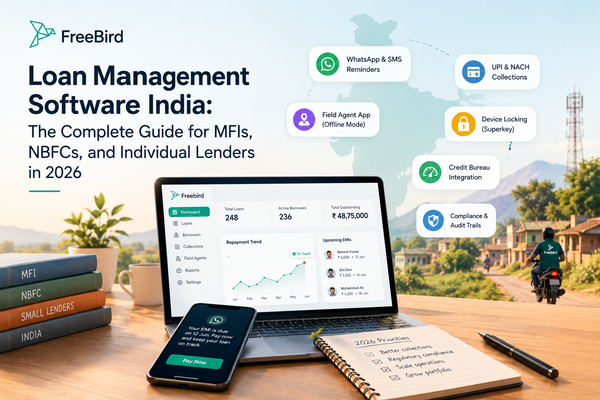
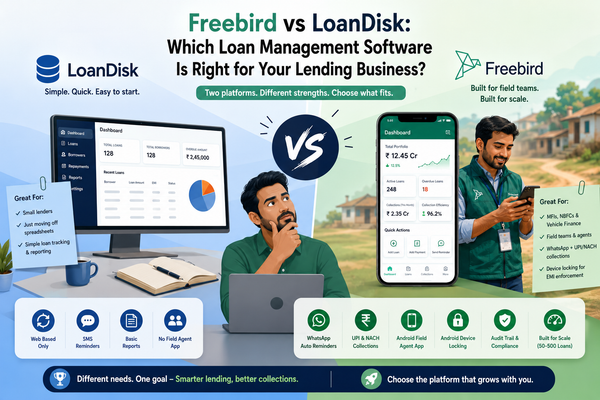
Freebird is loan management software built for MFIs, NBFCs, and individual lenders managing anywhere from 10 to 1,000+ active borrowers. It runs on web, Android, and iOS, and is designed to work without a dedicated IT team or a lengthy setup process.
What sets it apart from simpler apps:
- WhatsApp and SMS reminders sent automatically before due dates
- UPI and NACH auto-debit collection built in for India
- A real-time cash flow dashboard showing what's expected and what's overdue
- An Android field agent app with offline capability for collections in low-connectivity areas
- Full borrower communication logs for compliance purposes
- Superkey Android device locking for consumer EMI lenders — the only platform with this feature among the options currently available
- Credit bureau integration and AI calling (India, currently in pilot)
- Bank-grade encryption and biometric authentication via TouchID and FaceID
- PDF and Excel export for all loan data
- Multi-currency support for lenders outside India
Pricing runs across three tiers: Lite (up to 50 active loans), Professional (up to 500), and Team (unlimited). Exact pricing is shared during a sales conversation and varies by region. A 7-day free trial is available with no credit card required, and billing is month-to-month with no long-term contract.
If you're evaluating options, the fastest way to assess fit is to request a live demo at usefreebird.com.
Choosing the Right Platform for Your Portfolio Size
| Portfolio Size | What You Need | Right Fit |
|---|---|---|
| Under 50 loans | Basic tracking, reminders, simple reporting | Lite tier or free trial |
| 50–500 loans | WhatsApp automation, auto-debit, field agents | Professional tier |
| 500–5,000 loans | Compliance reporting, audit-trail enabled records, team access | Team tier or NBFC-focused platform |
| Device/EMI retailer | All of the above + Android device locking | Freebird specifically |
The key is matching the platform to your actual operational needs — not paying for a full origination-to-collections enterprise suite when what you need is a clean, fast tool that handles 200 borrowers and sends reminders on time.
FAQs
What is loan management software?
Loan management software is a platform that tracks loans and borrowers, calculates repayment schedules, automates payment reminders, processes collections, and generates compliance-friendly reports. It replaces manual spreadsheet tracking for lenders managing multiple active loans.
Is there free loan management software for small lenders?
Truly free options are limited and usually strip out the features that matter — no WhatsApp automation, no auto-debit, no compliance reporting. Most reputable platforms offer a free trial (typically 7 days) with full access so you can evaluate whether the software suits your portfolio before you pay.
What is the difference between loan management software and a loan origination system?
A loan origination system handles the application and approval process — credit checks, document collection, underwriting. Loan management software takes over after a loan is approved and tracks repayments, sends reminders, and manages collections. Some platforms combine both; many small lenders only need the management side.
Do I need loan management software if I only have 30 borrowers?
It depends on how much time you spend on follow-ups. If you're sending reminders manually and updating records by hand, even 30 borrowers can cost you several hours a week. A basic plan on a platform like Freebird covers up to 50 active loans and automates the most time-consuming parts of the job.
What features matter most for NBFCs and MFIs?
NBFCs (non-banking financial companies) and MFIs (microfinance institutions) operating under regulatory oversight need borrower communication logs, compliance-friendly reporting, and audit-trail enabled records. Field agent management and auto-debit collection are also important at scale.
Can loan management software help reduce defaults?
Yes, in a direct and measurable way. Automated reminders sent before due dates — not after a missed payment — change borrower behavior. Auto-debit mandates remove the friction of manual payment. For consumer device lenders, Superkey Android device locking adds a further enforcement layer that doesn't require phone calls or confrontation.
What should I look for in a free trial of loan management software?
Use the trial with real borrower data, not test data. Set up at least one automated reminder, run one repayment, and export one report. That tells you whether the interface is practical for daily use and whether the automation actually works the way it's described.
The right loan management software saves you hours every week, reduces the defaults that drain your portfolio, and keeps your records clean enough to hold up under a regulatory review. Start with a free trial, test it against your real workload, and make the decision based on what you see — not a feature list.
Request a live demo at usefreebird.com to see how Freebird handles your specific portfolio size and lending type.