How to Reduce Loan Defaults: A Practical Guide for Inividual Lenders in India 2026
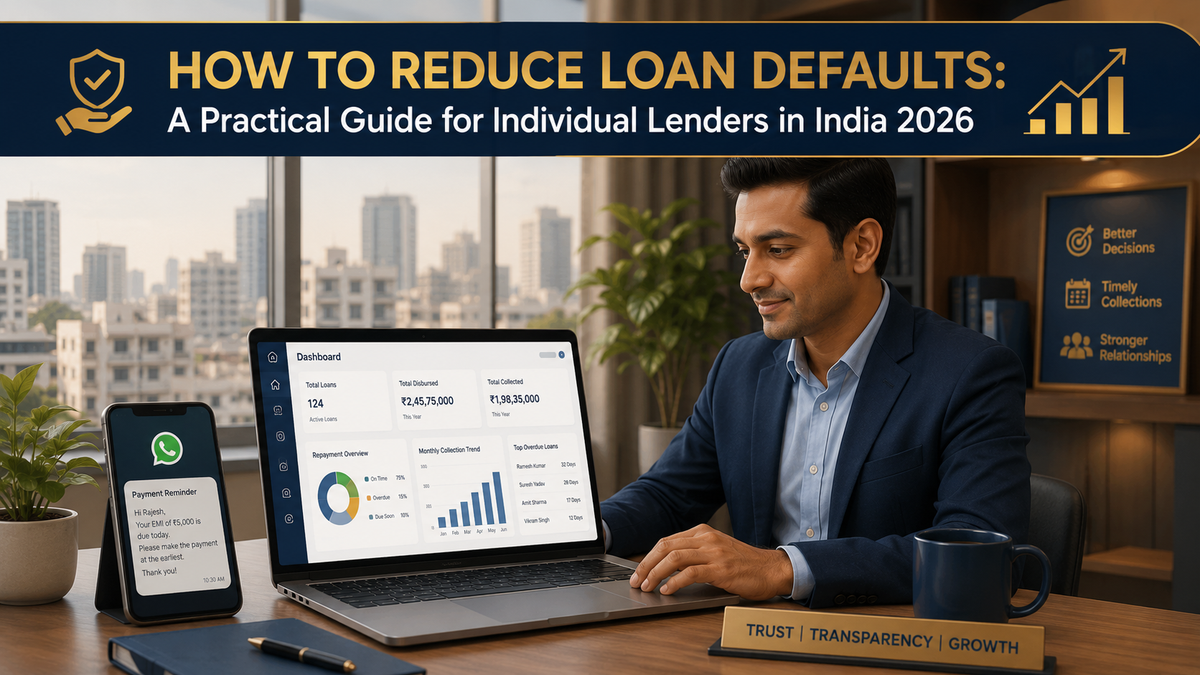
You already know the feeling. A borrower goes quiet after the second EMI. You call — no answer. You send a message — no reply. By the time you escalate, the loan is 60 days overdue and recovery has become expensive, slow, and uncertain.
This guide is not for someone setting up a lending business from scratch. It is for you — a private lender, a small microfinance institution (MFI), or an NBFC (non-banking financial company) operator who already has borrowers but is watching defaults eat into your margins.
Here is what is happening in the market right now, why defaults are harder to manage in 2026, and seven specific things you can do to stop losing money on loans you should have collected.
Why Defaults Are Getting Worse in 2026
The Reserve Bank of India's Financial Stability Report for March 2026 flagged a number that should concern every small lender: fintech small-ticket personal loan defaults rose to 6.4%. For a lender managing 200 active loans at an average ticket size of ₹30,000, that rate means roughly 12 to 13 loans in serious trouble at any given time.
The reasons are layered. Borrowers are taking loans from multiple lenders simultaneously. Income volatility in the gig economy means someone who was reliable in month one may face a genuine cash crunch by month four. And many small lenders are still relying on phone calls and manual follow-ups — tools that simply do not hold up once your portfolio grows past 50 borrowers.
The problem is not always the borrower. Often, it is the gap between when a borrower starts to struggle and when you find out.
The Real Cost of One Default
Before the strategies, do the math on a single default.
Take a ₹50,000 loan at 2% monthly interest over 12 months. If a borrower defaults at month four, you have collected roughly ₹20,000. You are still owed ₹30,000 in principal plus unpaid interest. Recovery — even if successful — takes time, legal fees, and field agent visits. If it fails, the loss is not just the principal. It is the opportunity cost of that capital sitting idle, the hours your team spent chasing it, and the administrative burden of documenting it for compliance.
One default at this scale costs you more than the interest income from three performing loans. That ratio is why default prevention is worth investing in.
7 Practical Strategies to Reduce Loan Defaults
1. Send WhatsApp Reminders Before the Due Date, Not After
Most lenders send a reminder when a payment is already late. That is the wrong sequence.
A borrower who gets a WhatsApp message two or three days before the due date has time to arrange funds. A borrower who gets a call on the day of default is already defensive. The psychology is different, and the outcome usually is too.
Analysis from the Zavo platform, which studied over 2.2 lakh EMI (equated monthly installment) payers, found that timely borrower engagement can prevent up to 85% of defaults. The operative word is timely — before the due date, not after.
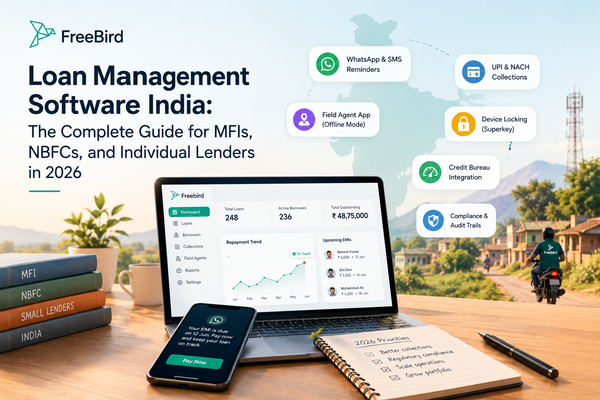
Sending these reminders manually across 100 or 200 borrowers is not realistic. Automated WhatsApp reminders, triggered by the loan schedule, make this consistent without adding hours to your week. Freebird's WhatsApp-native automation does exactly this — reminders go out on a schedule you set, without you touching a phone.
2. Set Up Auto-Debit Through UPI or NACH Mandate
A reminder is only as useful as the borrower's willingness to act on it. Auto-debit removes that dependency entirely.
When a borrower signs a NACH (National Automated Clearing House) mandate or a UPI AutoPay at the time of loan disbursement, the EMI is collected automatically on the due date. The borrower does not need to remember, initiate a transfer, or respond to a message. The money moves unless the account has insufficient funds — and even that gives you an early signal to act on.
This is one of the highest-impact changes a small lender can make. It shifts the default from a communication failure to a genuine inability-to-pay situation, which is a much smaller subset of your portfolio.
Both UPI mandates and NACH auto-debit are supported within Freebird's payment stack for lenders operating in India.
3. Improve Borrower Screening Before Disbursement
You cannot recover what you should not have lent. Screening is not about being restrictive — it is about being accurate.
For individual lenders and small MFIs, the most practical steps are:
- Check the credit bureau. Even a basic CIBIL check tells you whether the borrower has active loans elsewhere and whether they have a history of late payments.
- Verify income consistency. Three to six months of bank statements reveal whether income is regular or erratic. A borrower with volatile income needs a smaller loan and a more flexible repayment schedule.
- Ask about existing obligations. A borrower already repaying two loans is a higher risk than one with no current obligations, regardless of income level.
- Collect proper KYC documentation. Aadhaar, PAN, and address verification are not just compliance requirements — they are recovery tools if you ever need to locate a borrower.
Freebird supports credit bureau integration in India, so you can pull borrower data directly within the platform rather than running a separate check.
4. Start With a Smaller First Loan
This is one of the most effective risk management tools available to small lenders, and it costs you nothing.
A borrower who repays a ₹15,000 loan on time has demonstrated behavior, not just intent. Their second loan can be ₹30,000. Their third can be ₹50,000. This graduated approach builds a repayment track record before you extend significant credit.
Many MFIs already use this model, but individual lenders often skip it because a borrower asks for a larger amount upfront. The answer is to explain the process clearly at disbursement: repay this loan on time and the next one is larger. It aligns incentives and gives the borrower a reason to prioritize your EMI over others.
5. Use Field Agents for Early Delinquency, Not Late Recovery
Most lenders deploy field agents when a loan is 60 or 90 days overdue. By then, the borrower has already mentally categorized the debt as something they will deal with later — or not at all.
Early delinquency intervention is different. When a borrower misses a single EMI, a field agent visit or a personal call within 48 hours sends a clear signal: this lender pays attention. It also gives you information. Is the borrower facing a temporary cash flow problem? A family emergency? Do they have the intent to pay but need a short extension?
That conversation, held early, often resolves the situation without escalation. Held late, it becomes a collections problem.
Freebird's Android field agent app lets your agents manage borrower visits, log updates, and sync data even in areas with poor connectivity. You can assign follow-up tasks, track visit outcomes, and see which loans need attention — all from the dashboard.
6. Use Android Device Locking for EMI and Device Financing
If you finance mobile phones, electronics, or other consumer devices on EMI, you have a recovery tool that most lenders do not know exists.
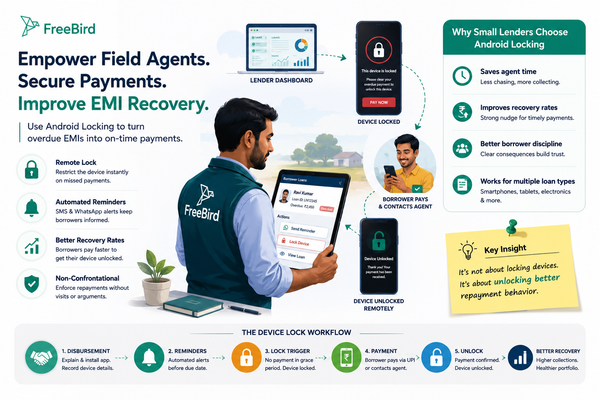
Freebird's Superkey feature lets you remotely restrict a borrower's Android device when an EMI payment is overdue. The device is not wiped or damaged — it is locked to a limited state until the payment clears, then restored automatically once the EMI is paid.
This changes the dynamic entirely. The borrower's device becomes a natural incentive for on-time payment. No confrontation, no field visit required, no legal process to initiate. The enforcement is built into the product they financed.
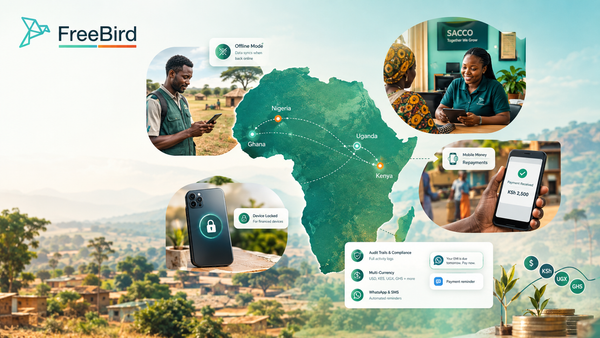
This feature is available for India and Africa. The RBI's June 2026 draft directions on phone locking have acknowledged this mechanism as a legitimate enforcement tool for device financing — a signal that the regulatory environment is moving toward formal recognition of what Freebird already does.
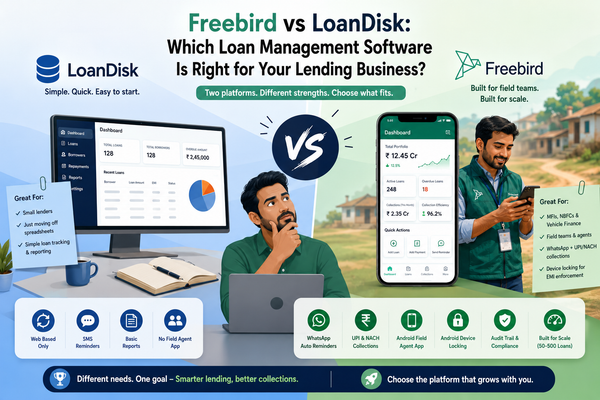
No other loan management platform currently offers a comparable device-locking feature. For EMI lenders in consumer electronics, this is not an optional add-on. It is the primary reason to use purpose-built software over a generic loan tracker.
7. Watch Your Cash Flow Dashboard for Early Warning Signs
Defaults rarely appear without warning. What usually happens is that a lender does not notice the signs until the loan is already in trouble.
A borrower who pays on time for six months and then pays three days late in month seven is showing you something. A cluster of late payments in a specific geography or loan segment tells you something about your portfolio composition. A sudden drop in collections in a given week may reflect broader economic stress in your borrower base.
None of this is visible in a spreadsheet. A real-time cash flow dashboard shows you what is coming in, what is overdue, and where the gaps are — before they become write-offs.
Freebird's dashboard gives you this visibility across your entire portfolio. Overdue loans, upcoming EMIs, collection rates by period, individual borrower status — all visible without pulling a report manually. For a lender managing 100 to 500 borrowers, that kind of visibility is the difference between catching a problem early and discovering it three months later.
How These Strategies Work Together
Each of these seven strategies reduces defaults on its own. Combined, they create a system where problems are caught before they escalate, and enforcement is built into the process rather than bolted on afterward.
Strategies 1 and 2 — WhatsApp reminders and auto-debit — address the most common cause of defaults: borrowers who intended to pay but did not follow through. Strategies 3 and 4 — screening and smaller first loans — filter out high-risk borrowers before disbursement. Strategy 5 catches problems in the first 30 days. Strategy 6 gives EMI lenders a passive enforcement mechanism. Strategy 7 gives you the visibility to act on all of the above.
Freebird automates strategies 1, 2, 5, and 6 directly within the platform — WhatsApp reminders, UPI and NACH auto-debit, field agent task management, and Superkey device locking. The remaining strategies are operational decisions that the platform supports with the right data and documentation.
A Note on Compliance
If you are operating as a registered NBFC or MFI, your default management process also needs to hold up under scrutiny. Borrower communication logs, repayment records, and field agent visit notes are not just useful for operations — they are what regulators ask for during inspections.
Freebird maintains full borrower communication logs, exportable in PDF and Excel, and is built to support compliance-ready reporting for small NBFCs and MFIs without requiring a dedicated compliance team.
The Bottom Line
A 6.4% default rate across your portfolio is not inevitable. Most defaults are preventable if you catch them early, communicate consistently, and have the right enforcement tools in place.
The lenders reducing defaults in 2026 are not doing anything exotic. They are sending reminders before due dates, collecting via mandate, screening borrowers properly, and using software that gives them real-time visibility across their portfolio.
If you are still managing this manually, the cost is not just the defaults you have already absorbed. It is the ones you are about to miss.
See how Freebird works for lenders at your scale at usefreebird.com.
Frequently Asked Questions
What is the most effective way to reduce loan defaults for individual lenders in India?
The highest-impact change most individual lenders can make is switching from manual follow-ups to automated pre-due-date reminders via WhatsApp, combined with UPI or NACH auto-debit mandates collected at disbursement. These two steps address the most common cause of defaults: borrowers who intended to pay but did not follow through in time.
What is an acceptable loan default rate for small MFIs and NBFCs in India?
There is no universal benchmark, but the RBI's March 2026 Financial Stability Report noted that fintech small-ticket personal loan defaults rose to 6.4%. Most well-managed small MFIs target a portfolio at risk (PAR 30) below 3 to 4%. If your default rate is above this, it is worth reviewing your screening process, reminder workflows, and early delinquency response.
How does Android device locking help reduce EMI defaults?
For lenders financing mobile phones or consumer electronics, Freebird's Superkey feature allows you to remotely restrict a borrower's Android device when an EMI is overdue. The device returns to normal function once the payment clears. This creates a direct, passive incentive for on-time payment without confrontation or field visits.
What is the difference between NACH and UPI AutoPay for loan repayment collection?
NACH is a bank-level mandate that debits the borrower's account on a fixed date. UPI AutoPay works similarly but operates through the UPI network and is often easier for borrowers to set up via a mobile app. Both eliminate the need for the borrower to initiate payment each month. For small lenders in India, UPI AutoPay is increasingly the faster option to implement.
When should a lender deploy a field agent for a delinquent loan?
The most effective window is within 48 hours of a missed first EMI — not at 60 or 90 days overdue. Early intervention gives you information about the borrower's situation and sends a clear signal that the loan is being actively monitored. Waiting until late delinquency makes recovery significantly harder and more expensive.
How many borrowers do you need before loan management software makes sense?
Most lenders find that manual tracking becomes unreliable somewhere between 30 and 50 active borrowers. At that point, missed reminders, incorrect balances, and overlooked overdue loans become frequent enough to cost real money. Freebird's Lite plan covers up to 50 active loans, so the transition does not require a large upfront commitment.
Does Freebird support credit bureau checks for borrower screening in India?
Yes. Freebird includes credit bureau integration for lenders operating in India, allowing you to pull borrower credit data directly within the platform during the loan origination process.