Best Loan Management Software for MFIs in Kenya and Uganda in 2026: What East African Lenders Need

Running a microfinance institution (MFI) in Kenya or Uganda in 2026 looks nothing like running one in the United States or India. Your borrowers repay via M-Pesa or Airtel Money. Your field agents travel to rural areas where mobile data cuts out mid-visit. Your regulators - the Central Bank of Kenya or Uganda's Microfinance Regulatory Authority — want clean borrower records and repayment histories, not a folder of WhatsApp screenshots.
Most loan management software was not built with any of that in mind.
This article covers what East African lenders specifically need from software, how the main options on the market hold up against those needs, and where Freebird fits for MFIs managing 50 to 2,000 active borrowers.
What East African MFIs Actually Need From Loan Software
Before comparing platforms, it helps to name the real operational requirements. These are not generic feature requests. They are the gaps that keep MFIs in Kenya and Uganda on spreadsheets longer than they should be.
Mobile Money Integration
In East Africa, mobile money is the primary payment rail. M-Pesa alone processed over 30 billion transactions in Kenya in 2025. Any loan management system that only supports bank transfers or UPI — India's domestic payment network — creates a manual reconciliation problem the moment a borrower repays via their mobile wallet.
Software needs to either connect directly with mobile money APIs or provide a clear workflow for recording and reconciling mobile money repayments without double-entry.
WhatsApp and SMS Over Email
Email open rates in rural East Africa are low. WhatsApp and SMS are how borrowers communicate, and they are how repayment reminders actually get read. A system that defaults to email, or treats WhatsApp as an optional add-on, will not move the needle on collections.
What you need: automated WhatsApp and SMS reminders sent before equated monthly installment (EMI) due dates, without a staff member manually sending each one.
Field Agent Tools That Work Offline
Many borrowers in Uganda and Kenya are in areas with unreliable mobile data. A field agent app that requires a live internet connection to log a collection visit is useless in those conditions. The software needs an Android app that works offline and syncs when connectivity returns.
Compliance-Friendly Reporting
MFIs in Kenya operate under Central Bank of Kenya guidelines. In Uganda, Tier 4 MFIs fall under the Uganda Microfinance Regulatory Authority (UMRA). Both require lenders to maintain borrower records, repayment histories, and communication logs in a format that can be produced on request.
Spreadsheets do not satisfy this. You need software that logs every disbursement, repayment, and borrower communication automatically — and lets you export that data when a regulator asks for it.
Affordable Pricing for Sub-500 Borrower Portfolios
Enterprise platforms built for US banks or large non-banking financial companies (NBFCs) price their software for portfolios of tens of thousands of loans. An MFI managing 200 active borrowers in Kampala cannot absorb a USD 20,000 annual software contract. Pricing has to fit the portfolio size.
How the Main Options Compare
Here is a structured look at the categories of software East African MFIs typically consider, assessed against those five requirements.
Local and Regional Platforms (Fibo360, Ensibuuko, BANKFUSE-style)
Platforms built specifically for East Africa understand the local context. Fibo360 in Kenya and Ensibuuko in Uganda are designed around savings and credit cooperative (SACCO) and MFI workflows, and some have mobile money integration built in.
The tradeoffs tend to be limited automation depth, thin mobile-first field agent tooling, and constrained scalability once a portfolio grows past a few hundred borrowers. WhatsApp automation is rarely a core feature. Pricing is generally accessible, though specific figures are not publicly listed for most regional platforms.
These tools work well for smaller SACCOs and community lenders but may not scale cleanly for an MFI moving from 100 to 1,000 borrowers.
Enterprise Western Platforms (LoanPro)
LoanPro is a US-based loan servicing platform built for large fintechs and financial institutions. Its pricing starts at USD 20,000 to 50,000 annually and requires dedicated IT teams to configure and maintain.
It has no native WhatsApp reminders, no Android device-locking capability, and no field agent management suited to emerging-market lending. It is not a realistic option for an MFI managing 50 to 500 loans in Nairobi or Jinja. It appears here because some lenders encounter it during research and need to understand why it does not fit.
Freebird
Freebird is a mobile-first loan management platform built for MFIs, village finance companies (VFCs), and small NBFCs managing 50 to 2,000 active borrowers. It is a global product with no geographic license restrictions, and it is actively used in both India and East Africa.
Here is how it maps to the five requirements:
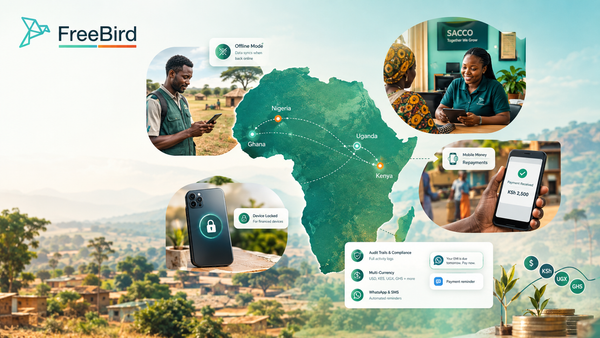
Mobile money compatibility: Freebird supports manual and digital payment recording with real-time cash flow tracking. Field agents can log mobile money repayments through the Android app, and the system maintains a full repayment ledger per borrower. Direct M-Pesa API integration is not listed as a current live feature, so if automated reconciliation with M-Pesa is a hard requirement, confirm this during a demo.
WhatsApp and SMS reminders: This is a core feature, not a bolt-on. Freebird sends automated WhatsApp and SMS payment reminders before due dates. No staff member needs to manually chase borrowers. Every message sent is logged, which also supports the compliance requirement.
Field agent app with offline capability: Freebird includes an Android field agent app designed for on-ground disbursement and collections. It works offline and syncs when connectivity is restored — which matters directly for rural Uganda and Kenya operations.
Compliance-friendly reporting: Every disbursement, repayment, and borrower communication is logged automatically. The system produces audit-trail-enabled records and supports PDF and Excel export for regulatory reporting. Borrowers also have their own mobile app showing payment history and upcoming EMIs, which reduces disputes.
Pricing for sub-500 portfolios: Freebird offers three tiers: Lite (up to 50 active loans), Professional (up to 500 active loans), and Team (unlimited active loans). Pricing is not published as a fixed figure and is shared during a sales conversation, but it is positioned as a cost-effective alternative to enterprise platforms. A 7-day free trial is available with no credit card required.
Side-by-Side Comparison
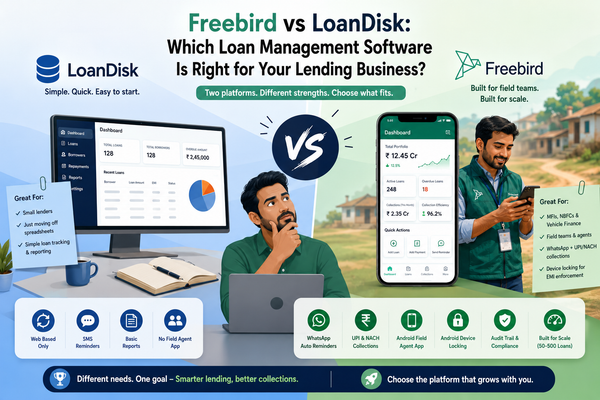
| Requirement | Local/Regional Platforms | LoanPro | Freebird |
|---|---|---|---|
| Mobile money workflow | Often integrated | Not applicable | Manual/digital recording; confirm M-Pesa API status |
| WhatsApp/SMS reminders | Rarely core | Not available | Core feature, automated |
| Offline field agent app | Limited | Not available | Android app, offline-capable |
| Audit-trail-enabled records | Varies | Yes (enterprise) | Yes, standard |
| Pricing for 50–500 borrowers | Accessible | USD 20k–50k/year | Lite/Professional tiers; demo for pricing |
| Borrower mobile app | Rare | No | Yes |
| Device locking for EMI assets | No | No | Yes (Android, Africa/India) |
The Feature No Competitor Offers: Superkey Device Locking
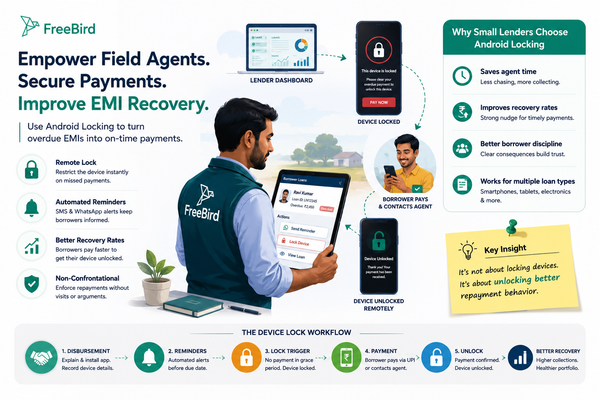
One feature worth naming specifically for East African lenders running device finance or EMI-based consumer lending programs is Freebird's Superkey capability.
Superkey is an Android device-locking feature. When a borrower who financed an Android device misses a payment, the lender can remotely restrict that device until the overdue amount is cleared. This applies only to Android devices and only where the device itself is the financed asset — a smartphone loan or device finance scheme, for example.
No other loan management platform in this comparison offers an equivalent. For MFIs in Kenya and Uganda that run device financing programs alongside their core loan portfolio, this is a meaningful operational tool.
What to Ask Any Vendor Before Signing Up
Whether you evaluate Freebird or any other platform, these are the questions that matter for East African operations:
- Does the system send WhatsApp reminders natively, or does it require a third-party integration you have to configure separately?
- Does the field agent app work offline, and how does it sync when connectivity returns?
- What does the audit trail look like, and can you export it in a format your regulator will accept?
- How does the system handle mobile money repayments recorded by field agents in the field?
- What is the pricing for a portfolio of your current size, and what happens to your data if you cancel?
Clear answers to these five questions will tell you more than any feature list.
Why India-First Vendors Miss the East African Context
Many affordable loan management platforms were built primarily for the Indian market. They are optimized for UPI payments, NACH auto-debit mandates, and Reserve Bank of India compliance requirements. These are real features — they are just not the primary needs of an MFI in Kampala or Mombasa.
The result is software that works well for its home market and requires workarounds everywhere else. WhatsApp automation may be present but configured around Indian regulatory norms. Payment integrations default to UPI rather than mobile money. Compliance reports are formatted for RBI rather than CBK or UMRA.
Freebird's global positioning means it is not tied to one market's payment rails or regulatory format. The WhatsApp automation, field agent app, and offline capability serve East African operations directly — not as an afterthought.
East Africa already accounts for approximately 16 percent of Freebird's organic search traffic, split roughly between Kenya and Uganda, without any dedicated regional marketing spend. That is organic demand from lenders actively searching for tools that fit their context.
Choosing the Right Tier for Your Portfolio
If you are an MFI or VFC in Kenya or Uganda, here is a straightforward way to think about which Freebird plan fits:
- Lite is for lenders with up to 50 active loans — typically individual money lenders or early-stage MFIs just moving off spreadsheets.
- Professional fits MFIs with up to 500 active borrowers, which covers most growing institutions in the region.
- Team is for institutions with over 500 borrowers and no ceiling on active loans.
Exact pricing for each tier is available through a demo conversation at usefreebird.com. The 7-day free trial lets you test the system with real borrower data before committing.
FAQs
What is loan management software, and why do MFIs in Kenya and Uganda need it?
Loan management software is a digital system that tracks borrower records, disbursements, repayments, and communications in one place. MFIs in Kenya and Uganda need it to replace spreadsheets, automate repayment reminders via WhatsApp and SMS, give field agents a mobile tool for rural collections, and maintain the audit-trail-enabled records that regulators require.
Does Freebird integrate with M-Pesa or mobile money in East Africa?
Freebird supports digital payment recording and real-time cash flow tracking. Field agents can log mobile money repayments through the Android app. For specific questions about direct M-Pesa API integration, confirm the current status during a demo at usefreebird.com.
What is the Superkey device-locking feature, and is it available in Kenya and Uganda?
Superkey is Freebird's Android device-locking capability. It allows a lender to remotely restrict a borrower's Android device when a payment is overdue, and it applies specifically to EMI-based consumer lending where the device is the financed asset. It is available in Africa, including Kenya and Uganda.
How does Freebird's field agent app handle areas with poor internet connectivity?
The Freebird Android field agent app supports offline use. Field agents can record disbursements and collections without a live internet connection, and the data syncs automatically when connectivity is restored.
What are Freebird's pricing tiers for East African MFIs?
Freebird offers three tiers: Lite (up to 50 active loans), Professional (up to 500 active loans), and Team (unlimited active loans). Specific pricing is shared during a sales conversation. A 7-day free trial is available with no credit card required.
How does Freebird compare to local platforms like Fibo360 or Ensibuuko?
Local platforms are built with East African context in mind and often include mobile money integration. Freebird's advantages are WhatsApp-native automation as a core feature, an offline-capable field agent app, audit-trail-enabled compliance reporting, and a borrower mobile app — combined with a pricing structure designed for portfolios of 50 to 500 borrowers.
What compliance reporting does Freebird provide for Kenyan and Ugandan regulators?
Freebird automatically logs every disbursement, repayment, and borrower communication. Records can be exported as PDF or Excel files. The system is designed to be compliance-friendly for regulated lenders, though you should confirm that specific report formats meet your local regulator's requirements during a demo.
Start With a Demo, Not a Spreadsheet
If your MFI in Kenya or Uganda is still managing borrowers on Excel, the cost is not just time. It is missed collections, no audit trail, and field agents working without a reliable system.
The right software does not need to be expensive or built for a market that is not yours. It needs to send WhatsApp reminders before due dates, give your field agents an offline-capable app, and keep records your regulator can read.
Request a live demo at usefreebird.com to see how Freebird handles your specific portfolio size and operational setup.