Best Collections and Reminder Automation for NBFCs in India 2026: Features, Compliance, and Pricing Compared
If you run a non-banking financial company (NBFC) or microfinance institution (MFI) in India, you already know what a missed reminder costs you. A borrower skips an equated monthly installment (EMI). You call. No answer. You call again. Three days later, you have a delinquency that a single WhatsApp message — sent two days before the due date — could have prevented.
This article covers what to look for in a collections automation platform built for Indian NBFCs, how pre-due and post-due reminder workflows actually function, and how the main options in 2026 stack up on the features that matter most to small and mid-size lenders.
Why Collections Automation Matters More Than Ever for NBFCs in 2026
The Reserve Bank of India has sharpened its supervisory focus on NBFCs over the past few years. Audit trails, borrower communication records, and documented collection practices are no longer optional for regulated lenders. Meanwhile, portfolios are growing. A lender managing 200 active borrowers on a spreadsheet is spending 3 to 5 hours a week on manual follow-ups alone — time that compounds into real money as the portfolio scales.
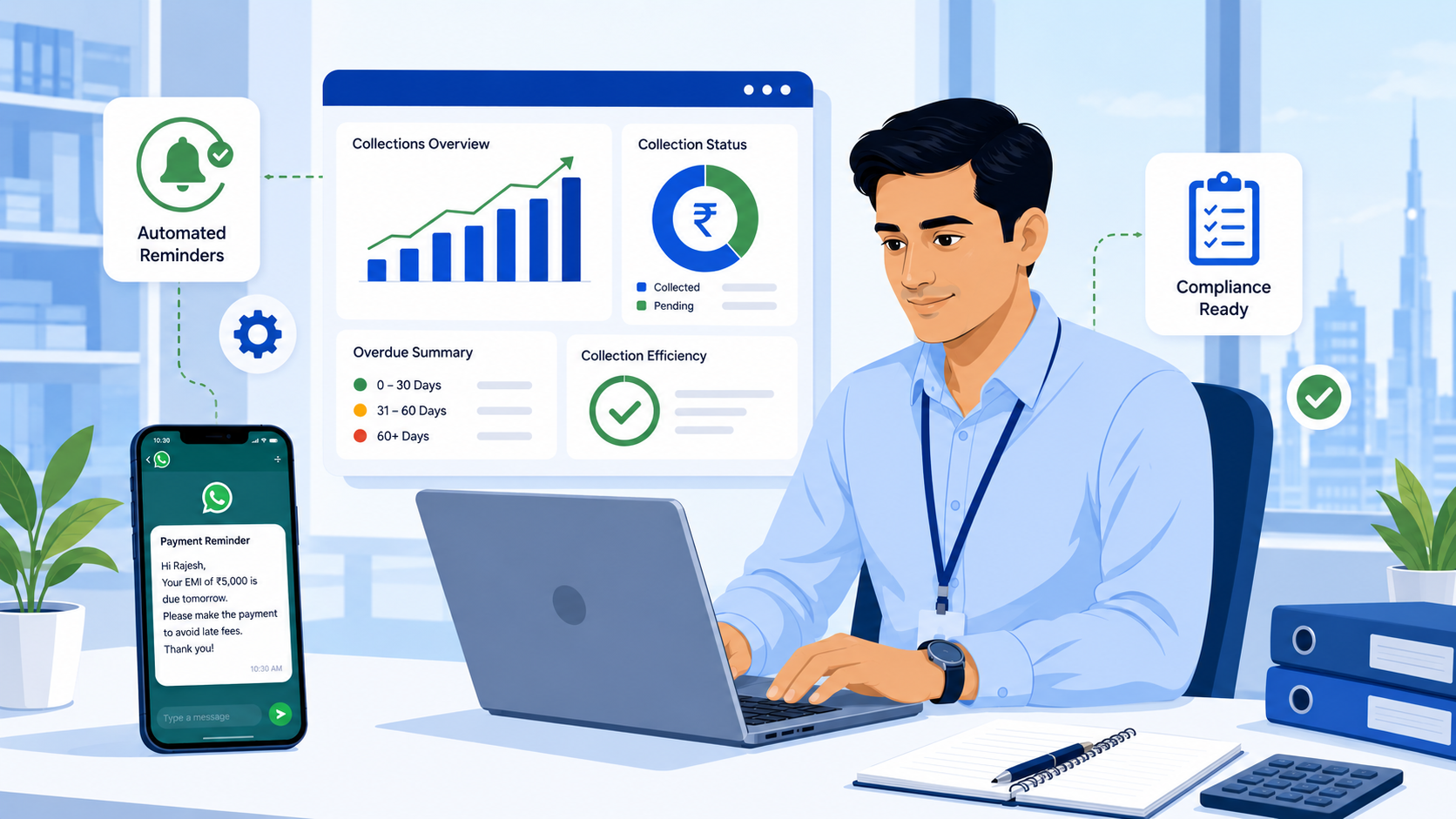
Collections automation addresses both problems. It sends reminders before payments are due, cutting the number of borrowers who miss dates simply because they forgot. It also creates a timestamped log of every communication, which matters the moment an auditor asks for documentation.
The question is not whether to automate. It is which platform handles pre-due and post-due reminders in a way that actually fits how Indian NBFCs operate.
What Pre-Due and Post-Due Reminder Automation Actually Means
These two terms come up constantly, but they describe different problems.
Pre-due reminders go out before the payment date — typically two or three days ahead of an EMI. This is the highest-value touchpoint in collections because it prevents a missed payment rather than chasing one. Most defaults are not intentional. A well-timed reminder is often enough.
Post-due reminders go out after a payment has been missed. They need to be timely, firm, and documented. A platform that waits for manual intervention to trigger post-due messages is not automating collections — it is just giving you a fancier spreadsheet.
A strong collections platform handles both stages without you touching anything. It also needs to work on the channels your borrowers actually check, which in India means WhatsApp first, SMS second.
Key Features to Look for in an NBFC Collections Platform
Not every feature on a vendor's list carries equal weight. For an Indian NBFC managing 50 to 1,000 active loans, these are the ones worth evaluating carefully.
WhatsApp and SMS Reminder Automation
WhatsApp is not a nice-to-have for Indian borrowers — it is the primary communication channel. Any platform that treats it as an add-on or charges extra for it is not built for this market.
Look for reminders that trigger automatically based on due date, not manual input. You should be able to configure the timing — three days before, one day before, one day after — and let the system run.
Auto-Debit and UPI Integration
Reminders work better when they include a payment link. Platforms that connect reminders to UPI payment flows reduce the friction between a borrower receiving a message and actually paying. Auto-debit mandates go further, pulling payments automatically on due dates without requiring any borrower action at all.
Compliance-Ready Audit Trails
Every reminder sent, every payment received, and every borrower interaction should be logged with a timestamp. This is not about surveillance — it is about being able to show a regulator that your collection practices are documented and consistent.
Field Agent Management
Many Indian NBFCs rely on field agents for on-ground collections, particularly in semi-urban and rural areas. A platform that only handles digital reminders leaves a gap for everything that happens in person. Field agent apps that log disbursements, collections, and borrower visits close that gap.
Cash Flow Visibility
Knowing which payments are due this week, which are overdue, and what is expected next month is basic operational intelligence. A real-time dashboard that shows this lets you plan ahead instead of reacting.
How the Main Platforms Compare in 2026
Freebird
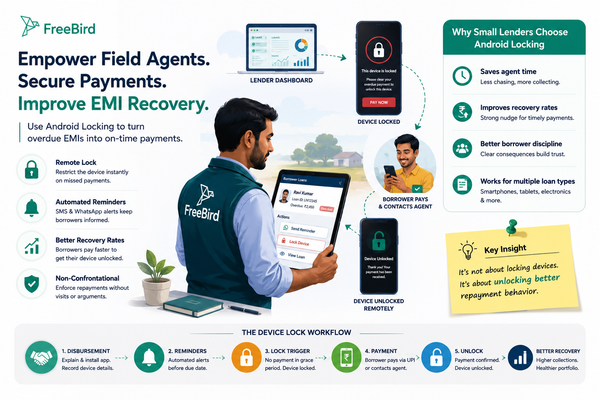
usefreebird.com is built specifically for individual money lenders, MFIs, and NBFCs managing anywhere from 10 to 1,000 or more active borrowers. Pre-due and post-due reminders go out automatically via WhatsApp and SMS, based on due dates you configure. Nothing is triggered manually.
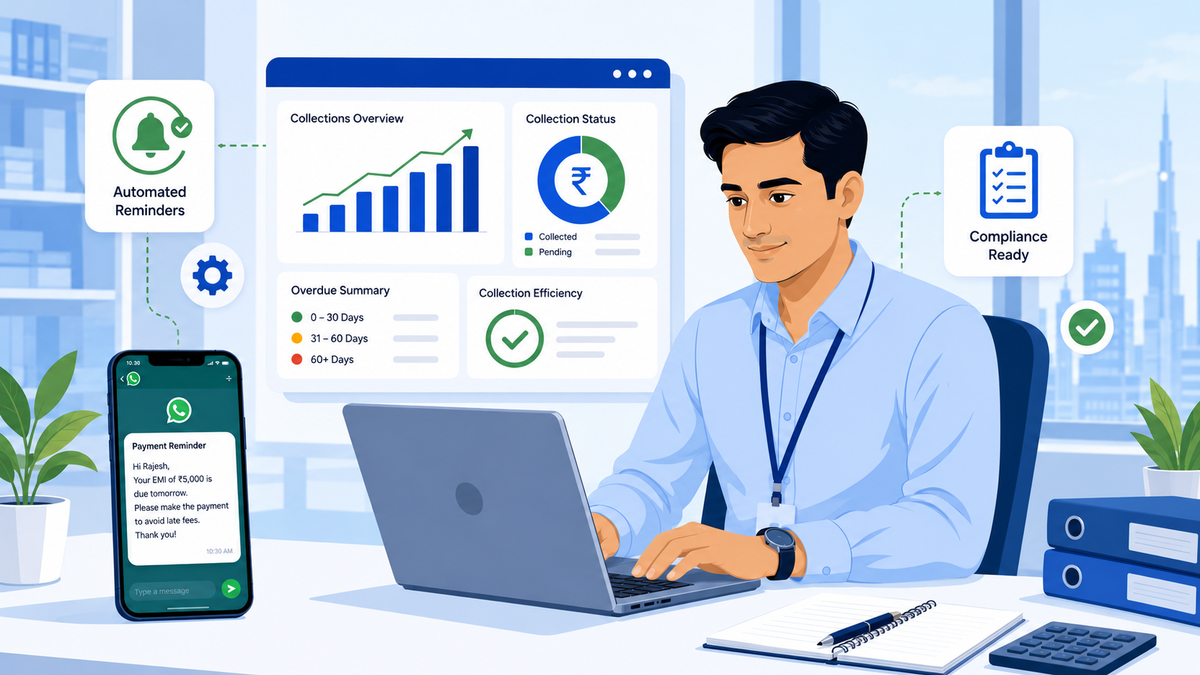
Auto-debit and UPI payment integrations are included, so borrowers can pay directly from the reminder message. The real-time dashboard shows collection status, upcoming EMIs, and cash flow forecasts without requiring you to build any reports yourself.
For NBFCs, compliance is handled through full borrower communication logs and audit-ready reporting. Every reminder, every payment, and every interaction is timestamped and exportable in PDF or Excel.
Freebird also includes a field agent app for on-ground collections and loan disbursement — a meaningful gap-filler for lenders whose portfolios are not fully digital.
The feature that sets Freebird apart from every competitor is the optional Android device-locking capability. For NBFCs and retailers offering device financing or consumer electronics on EMI, this allows remote restriction of a borrower's Android device when a payment is overdue. The device unlocks automatically once the payment clears. No comparable feature exists in any other platform currently available in this market.
Pricing runs across three tiers: Lite (up to 50 active loans), Professional (up to 500 active loans), and Team (unlimited active loans). Exact pricing is shared during a demo conversation. A 7-day free trial is available with no credit card required, and billing is month-to-month with no long-term contracts.
Lendstack
Lendstack targets small informal lenders moving off paper-based records. It offers UPI payment collection alongside WhatsApp and SMS reminders, and for a very small portfolio, it covers the basics.
The gaps become visible as your portfolio grows. There is no field agent management, no compliance-ready reporting, no cash flow dashboard, and no device-locking. It is primarily a mobile app with limited web presence. If you are managing 50 or more active loans and need audit documentation, Lendstack is likely to fall short.
AllCloud
AllCloud targets mid-market NBFCs and banks in India with a full origination-to-collections suite. It is a more complete product for large institutions, but the complexity is excessive for a lender managing 50 to 500 loans. Pricing is on annual contracts and is demo-gated. There is no evidence of native WhatsApp reminder flows or device-locking, and implementation typically requires dedicated IT involvement.
LoanPro
LoanPro is a capable enterprise platform built for large US-based financial institutions. It costs between $20,000 and $50,000 per year, requires dedicated IT teams, and has no native WhatsApp integration, no device-locking, and no field agent management suited to Indian operations. It is not a realistic option for Indian NBFCs or MFIs.
Credgenics
Credgenics is focused on NPA (non-performing asset) recovery and legal collections for large institutional lenders. It is not designed for day-to-day loan tracking or pre-due reminder automation for small portfolios — it serves a different use case entirely.
A Practical Reminder Workflow for Indian NBFCs
Here is what an automated reminder sequence looks like when it is set up correctly.
Day -3 (3 days before due date): WhatsApp message to the borrower with EMI amount, due date, and payment link.
Day -1 (1 day before due date): SMS reminder with the same information — shorter and direct.
Day 0 (due date): Auto-debit attempt if a mandate is in place. If not, a final WhatsApp reminder.
Day +1 (1 day after missed payment): Post-due WhatsApp message noting the missed payment and providing a payment link.
Day +3 to +7: Escalation to a field agent if payment has not been received. The agent visit is logged in the system.
Every step is documented. If a borrower later disputes a communication, you have the log. If an auditor asks for your collection process, you have the trail.
This is the workflow Freebird is built to run without manual intervention at each stage.
Compliance Considerations for NBFC Collections in 2026
The RBI's Fair Practices Code for NBFCs requires that borrower communications be respectful, documented, and consistent. Automated reminder platforms that log every message sent, received, and read satisfy this requirement in a way that phone-based manual follow-ups simply cannot.
Audit-ready platforms should provide:
- Timestamped records of every borrower communication
- Logs showing which reminders were sent and when
- Payment history tied to each borrower account
- Exportable reports for regulatory review
If your current process relies on a field agent calling borrowers from a personal phone, you have no documentation of those interactions. That is a compliance gap that grows more serious as your portfolio grows.
Choosing the Right Platform for Your Portfolio Size
- Under 50 active loans → Freebird Lite or Lendstack (basic needs)
- 50 to 500 active loans → Freebird Professional
- 500 to 1,000+ active loans → Freebird Team or AllCloud (if full origination suite needed)
- Device financing / EMI lending → Freebird (device-locking is unique to this platform)
- Large institutional NPA recovery → Credgenics
For most Indian NBFCs and MFIs managing between 50 and 500 borrowers, the decision comes down to whether you need compliance reporting and field agent management alongside reminder automation. If you do, Freebird is the only platform in this price range that covers all three.
Conclusion
Pre-due reminders prevent defaults. Post-due reminders shorten the gap between a missed payment and recovery. Audit trails protect you during regulatory reviews. Field agent management covers what digital reminders cannot reach on their own.
For Indian NBFCs in 2026, a platform that handles all of this without requiring a dedicated IT team or a long-term contract is a practical operational choice — not a luxury. If your portfolio has grown past what a spreadsheet handles comfortably, or a recent default exposed gaps in your collection process, it is worth seeing how a purpose-built platform actually works.
Request a live demo at
usefreebird.com to see the reminder automation, compliance reporting, and field agent features in a walkthrough built around your portfolio size.
Frequently Asked Questions
What is the difference between pre-due and post-due reminder automation for NBFCs? Pre-due reminders go out before a payment is due — typically 1 to 3 days in advance — to reduce the number of borrowers who miss payments simply because they forgot. Post-due reminders go out after a payment has been missed and are part of the early collections process. Both should be automated and logged to satisfy compliance requirements.
Which channels work best for NBFC payment reminders in India? WhatsApp is the most effective channel for Indian borrowers because of its high open rates and support for direct payment links. SMS is a reliable backup for borrowers who do not use WhatsApp regularly. A platform that supports both channels and automates sequencing across them will cover most of your portfolio.
Does Freebird support UPI payment collection? Yes. Freebird integrates with UPI for digital payment collection in India. Borrowers can pay directly from a reminder message, which reduces friction and increases same-day payment rates.
What compliance documentation does an NBFC need for collections? Under the RBI's Fair Practices Code, NBFCs are expected to maintain records of borrower communications, collection practices, and payment histories. A platform with timestamped communication logs and exportable audit reports satisfies these requirements in a format that can be sh